
Insulin resistance belly fat is fat that collects mainly around the waist and internal organs while the arms and legs stay relatively lean. It forms when insulin stays high for much of the day and keeps the body in storage mode. Fasting windows, protein and fiber, strength training, walking, and sleep all lower insulin and shrink this fat.
Compare 7 GLP-1 providers side by side →
Or see our $59/month option →
Insulin Resistance Belly Fat: Quick Answer
Insulin resistance belly fat is fat stored mainly around the waist and organs, driven by insulin that stays high most of the day. A waist under half your height is the target. Daily fasting windows, protein and fiber, strength training, walks after meals, and 7 to 9 hours of sleep lower insulin and shrink visceral fat.
- Belly-dominant fat is a classic outward sign of insulin resistance.
- Waist-to-height ratio under 0.5 is the simple home check.
- Visceral fat is often the first fat to shrink when habits change.
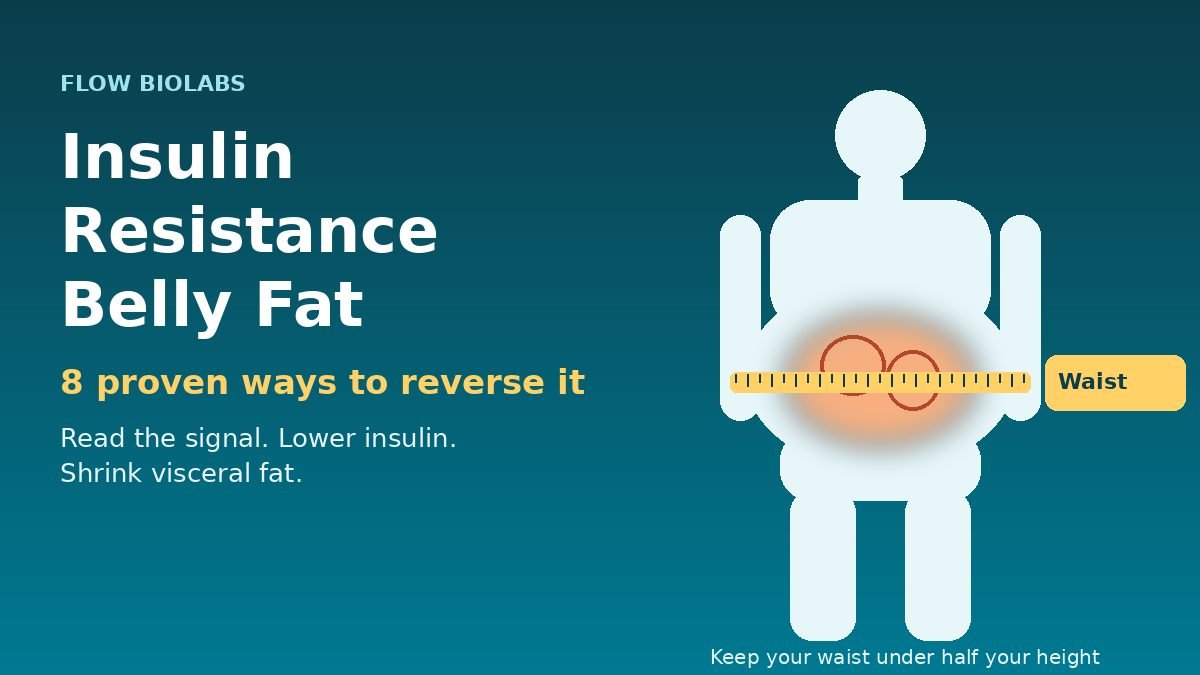
Your body runs on signals, and your waistline is one of the easiest to read. Insulin resistance belly fat is a pattern researchers and clinicians have studied for decades, and the response to it is well mapped. This guide explains what the pattern means, how to measure it at home, and exactly what each step in the action plan does.
What is insulin resistance belly fat?
Insulin is the body’s main storage hormone. After you eat, insulin rises and signals your cells to take in glucose and store extra energy as fat. Between meals, insulin falls and the body can draw on that stored energy.
Insulin resistance develops when cells respond less to that signal. The pancreas compensates by releasing more insulin. With insulin elevated most of the day, the body stays in storage mode and stored fat is harder to release.
The fat that builds under these conditions tends to collect in the abdomen. That is why insulin resistance belly fat has a recognizable shape: a firm, rounded midsection with comparatively slim limbs.
Why belly fat is a sign of insulin resistance
Not all fat behaves the same way. Subcutaneous fat sits just under the skin. Visceral fat sits deeper, wrapped around the liver, intestines, and pancreas. You can learn more about how location changes fat’s behavior in The Hidden Map of Body Fat (Part 2).
Visceral fat drains directly into the portal vein, which runs straight to the liver. Researchers describe this as the “portal theory”: the liver receives a steady flow of free fatty acids and inflammatory signals from visceral fat, which promotes liver insulin resistance and fat buildup in the liver (Item & Konrad, 2012). Visceral fat also releases inflammatory messengers that push insulin resistance body-wide (Milić et al., 2014). That liver connection is why insulin resistance belly fat so often travels with fatty liver.
Waist size is so closely tied to insulin resistance that it is one of the five official criteria for metabolic syndrome. The American Heart Association and National Heart, Lung, and Blood Institute set the waist marker at more than 40 inches for men and more than 35 inches for women (Grundy et al., 2005).
How to spot insulin resistance belly fat at home
You can read this signal at home in under two minutes, then confirm it with standard lab work.
1. Waist-to-height ratio. Measure your waist at the navel and divide by your height, both in the same units. The UK’s National Institute for Health and Care Excellence (NICE) advises keeping your waist to less than half your height, a ratio under 0.5 (NICE). A 5-foot-10 (70-inch) adult, for example, would aim for a waist under 35 inches.
2. Waist circumference. Compare your measurement with the 40-inch (men) and 35-inch (women) markers above.
3. Skin signals. Dark, velvety patches on the back of the neck, armpits, or skin folds are called acanthosis nigricans. Dermatology reviews describe it as a visible skin marker of insulin resistance (Leung et al., 2022).
4. The lab panel clinicians typically look at. These tests show how hard your body is working to manage blood sugar:
- Fasting insulin
- Fasting glucose
- HbA1c
- Triglycerides and HDL cholesterol (their ratio)
- HOMA-IR, calculated from fasting insulin and glucose
Fasting insulin is not part of every standard checkup, so it is worth asking for by name. For context on what these numbers mean, see The Lab Numbers Worth Discussing With a Clinician and Prediabetes Symptoms.
Why insulin resistance belly fat responds quickly
Here is the encouraging part about insulin resistance belly fat. Visceral fat is highly active tissue, and it is often the first fat to shrink when habits change.
A systematic review of 61 weight-loss studies found that modest weight loss produced a proportionally larger drop in visceral fat than in the fat under the skin (Chaston & Dixon, 2008). In practice, the waistline and the lab panel often improve before the scale shows dramatic change.
8 proven ways to reverse insulin resistance belly fat
Each step below works on the same root signal: lowering how much insulin your body needs and how long it stays high. Here is what each one does when done consistently.
1. Open a daily fasting window
What to do: Finish dinner earlier and push breakfast later until you reach 12 hours without food. Build to 14 to 16 hours as it feels comfortable. Water, black coffee, and plain tea fit inside the window.
What it does: Every hour without food lets insulin fall. Low insulin is the signal that unlocks stored fat so the body can burn it. A daily fasting window creates that low-insulin stretch on a predictable schedule.
The result when done right: An umbrella review of randomized trials found that intermittent fasting reduced waist circumference, fat mass, and fasting insulin in adults with overweight compared with no diet change (Sun et al., 2024). Timing adds a bonus. In a controlled feeding trial, men with prediabetes who ate within a 6-hour window ending by 3 p.m. improved insulin sensitivity, blood pressure, and oxidative stress, even without losing weight (Sutton et al., 2018). An earlier eating window works with your body clock. For a practical approach, read Why Fasting Is a Tool, Not a Religion.
2. Build every meal around protein and fiber
What to do: Start each meal with a palm-sized portion of protein and a generous serving of vegetables, beans, or other fiber-rich foods. Eat starches last.
What it does: Protein and fiber slow how fast glucose enters the blood. A slower rise means a smaller insulin spike, and you stay full longer, which makes the fasting window easier.
The result when done right: Soluble fiber targets visceral fat specifically. In a five-year study using CT scans, each 10-gram daily increase in soluble fiber was linked to a 3.7% slower rate of visceral fat buildup (Hairston et al., 2012). Good sources include oats, beans, lentils, chia seeds, apples, and Brussels sprouts. More on this in Fiber: The Quiet Tool Almost Every Plan Forgets.
3. Swap refined carbs and sugary drinks for whole foods
What to do: Replace soda, juice, white bread, pastries, and packaged snacks with whole foods: vegetables, fruit, legumes, eggs, fish, meat, nuts, and intact grains.
What it does: Refined carbohydrates and sugary drinks digest fast and trigger the largest, most frequent insulin surges. Removing them takes the biggest daily pressure off your insulin system and off your liver.
The result when done right: Fewer insulin surges, steadier energy between meals, and a better triglyceride reading on your next lab panel.
4. Lift weights two to three times a week
What to do: Train all major muscle groups with weights, bands, or bodyweight two to three times a week. Squats, rows, presses, and carries cover most of the body.
What it does: Skeletal muscle is the body’s largest glucose sink. It handles the majority of insulin-driven glucose uptake, and insulin resistance in muscle is a central driver of type 2 diabetes (DeFronzo & Tripathy, 2009). More muscle, and more active muscle, means more places for glucose to go with less insulin needed.
The result when done right: Better blood sugar control around the clock, including while you rest. Strength becomes even more valuable with age, as covered in Why Strength Training Matters More After 40.
5. Take short walks, especially after meals
What to do: Walk for 10 to 15 minutes after your largest meals, and break up long stretches of sitting with a few minutes of light walking.
What it does: Working muscles pull glucose out of the bloodstream through a pathway that does not depend on insulin. That eases the load right when blood sugar peaks.
The result when done right: A meta-analysis of randomized crossover trials found that breaking up prolonged sitting with light walking significantly lowered both post-meal glucose and insulin compared with continuous sitting (Buffey et al., 2022). See The 10-Minute Walk That Quietly Changes Everything.
6. Add regular cardio or intervals
What to do: Aim for regular aerobic sessions such as brisk walking, cycling, swimming, or interval training most days of the week.
What it does: Regular aerobic exercise is especially effective at shrinking visceral fat.
The result when done right: A meta-analysis of 117 studies found that exercise reduced visceral fat by about 6.1% even when body weight did not change (Verheggen et al., 2016). This is why your waist can shrink while the scale holds steady, so track your tape measure, not just your weight.
7. Sleep 7 to 9 hours on a steady schedule
What to do: Keep a consistent bedtime and wake time, and protect at least seven hours in bed asleep.
What it does: Sleep helps the brain regulate the hormones that govern hunger, stress, and blood sugar. A well-rested brain sends steadier signals to the rest of the body.
The result when done right: Sleep protects every other gain on this list. In a clamp study, a single night of 4 hours’ sleep cut insulin sensitivity by about 25% in healthy adults (Donga et al., 2010). Consistent sleep keeps that sensitivity high. Practical habits are in Sleep Schedule Consistency.
8. Calm your stress response
What to do: Build daily recovery into your routine: slow breathing, time outdoors, social connection, and short breaks from screens.
What it does: Chronic stress keeps the brain’s stress axis switched on, raising cortisol. Reviews show this pattern promotes visceral fat accumulation (Paredes & Ribeiro, 2014) and can raise cortisol and insulin together (Epel, 2009).
The result when done right: Less signal to store fat in the belly, fewer stress-driven cravings, and better sleep. Your brain is the master signal here. For more, read Stress Isn’t a Side Note in Weight Loss.
Getting started safely
If you take medication for blood sugar or blood pressure, or if you are pregnant, plan any fasting schedule with your clinician first. As insulin sensitivity improves, medication doses sometimes need adjusting, and a licensed clinician can guide that safely.
This article is for education and is not medical advice. Work with a licensed clinician for diagnosis and treatment.
How to track your insulin resistance belly fat progress
- Waist: measure monthly at the navel, at the same time of day, after exhaling normally.
- Waist-to-height ratio: recalculate each month and watch it move toward 0.5.
- Labs: repeat fasting insulin, glucose, HbA1c, and triglycerides every 3 to 6 months.
- Daily signals: steadier energy, fewer cravings, and deeper sleep can show up within the first few weeks.
Not sure where to start? Take the free Metabolic Friction Assessment to see which signals to prioritize first.
Frequently asked questions
Is belly fat a sign of insulin resistance?
Yes. Fat concentrated around the waist, with leaner arms and legs, is one of the clearest outward signs of insulin resistance. Waist size is an official metabolic syndrome criterion for this reason. Lab tests such as fasting insulin and HOMA-IR confirm the picture.
How do I know if I have insulin resistance?
Start with your waist-to-height ratio and look for dark, velvety skin patches. Then ask your clinician for fasting insulin, fasting glucose, HbA1c, and a lipid panel. Together these give a clear view of how your body is handling insulin.
What is the fastest way to lose visceral fat?
Combine a daily fasting window, protein and fiber at every meal, regular exercise, and consistent sleep. Exercise reduces visceral fat even without weight loss, and visceral fat tends to shrink first with modest weight loss.
Can you reverse insulin resistance belly fat?
Yes. Insulin sensitivity responds to food timing, food quality, muscle, movement, sleep, and stress. Many people see their waist measurement and lab numbers improve within weeks to months of consistent change.
Does fasting help insulin resistance?
Yes. Fasting windows lower insulin for extended periods. Trials show intermittent fasting reduces waist circumference and fasting insulin, and eating earlier in the day improves insulin sensitivity even without weight loss.
Your next step
Insulin resistance belly fat is a signal, and signals can change. Lower insulin, build muscle, move after meals, and protect your sleep, and your waistline will follow.
Go deeper with The Signal Course. Module 2 covers glucose and insulin sensitivity in depth, with a guided, week-by-week plan built around these exact signals. See Module 2 →
Sources
- Item F, Konrad D. Visceral fat and metabolic inflammation: the portal theory revisited. Obes Rev. 2012. https://doi.org/10.1111/j.1467-789X.2012.01035.x
- Milić S, Lulić D, Štimac D. Non-alcoholic fatty liver disease and obesity: biochemical, metabolic and clinical presentations. World J Gastroenterol. 2014. https://doi.org/10.3748/wjg.v20.i28.9330
- Grundy SM, et al. Diagnosis and management of the metabolic syndrome: an AHA/NHLBI Scientific Statement. Circulation. 2005. https://pubmed.ncbi.nlm.nih.gov/16157765/
- NICE. Keep the size of your waist to less than half of your height. https://www.nice.org.uk/news/articles/keep-the-size-of-your-waist-to-less-than-half-of-your-height-nice–recommends
- Leung AKC, et al. Acanthosis Nigricans: An Updated Review. Curr Pediatr Rev. 2022. https://doi.org/10.2174/1573396318666220429085231
- Chaston TB, Dixon JB. Factors associated with percent change in visceral versus subcutaneous abdominal fat during weight loss. Int J Obes. 2008. https://doi.org/10.1038/sj.ijo.0803761
- Sun ML, et al. Intermittent fasting and health outcomes: an umbrella review. eClinicalMedicine. 2024. https://doi.org/10.1016/j.eclinm.2024.102519
- Sutton EF, et al. Early time-restricted feeding improves insulin sensitivity, blood pressure, and oxidative stress even without weight loss in men with prediabetes. Cell Metab. 2018. https://doi.org/10.1016/j.cmet.2018.04.010
- Hairston KG, et al. Lifestyle factors and 5-year abdominal fat accumulation in a minority cohort: the IRAS Family Study. Obesity. 2012. https://doi.org/10.1038/oby.2011.171
- DeFronzo RA, Tripathy D. Skeletal muscle insulin resistance is the primary defect in type 2 diabetes. Diabetes Care. 2009. https://doi.org/10.2337/dc09-S302
- Buffey AJ, et al. Interrupting prolonged sitting with standing and light-intensity walking: a systematic review and meta-analysis. Sports Med. 2022. https://doi.org/10.1007/s40279-022-01649-4
- Verheggen RJHM, et al. Exercise training versus hypocaloric diet: distinct effects on body weight and visceral adipose tissue. Obes Rev. 2016. https://doi.org/10.1111/obr.12406
- Donga E, et al. A single night of partial sleep deprivation induces insulin resistance in multiple metabolic pathways in healthy subjects. J Clin Endocrinol Metab. 2010. https://doi.org/10.1210/jc.2009-2430
- Paredes S, Ribeiro L. Cortisol: the villain in metabolic syndrome? Rev Assoc Med Bras. 2014. https://doi.org/10.1590/1806-9282.60.01.017
- Epel ES. Psychological and metabolic stress: a recipe for accelerated cellular aging? Hormones. 2009. https://doi.org/10.14310/horm.2002.1217
Compare 7 GLP-1 providers side by side →
Or see our $59/month option →