Your ring keeps telling youyour deep sleep is low.
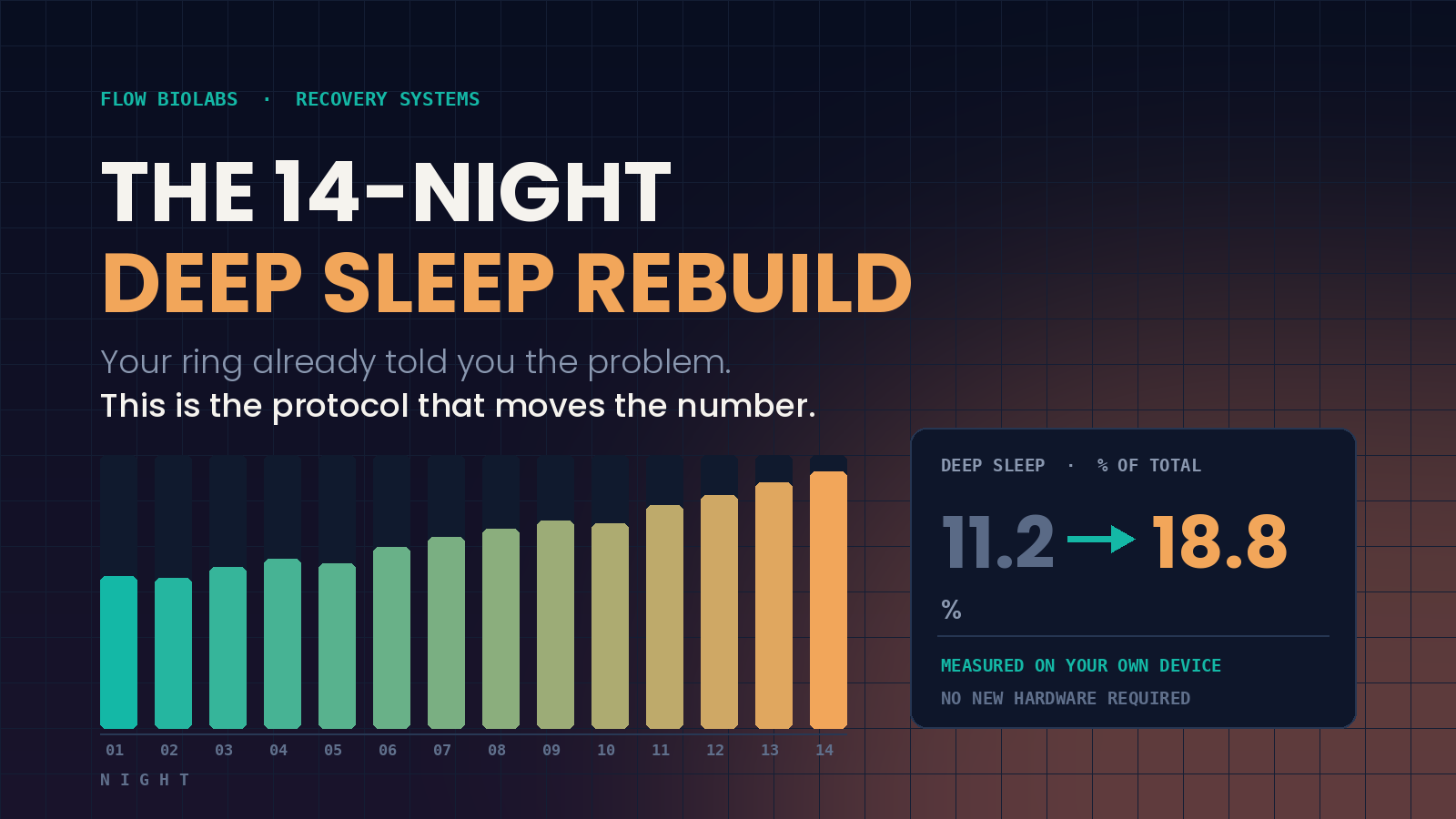
It never tells you what to do about it. This does — one lever per night, for fourteen nights, measured on the device you already own.
 Start Night 1 Tonight — $47
You didn’t buy the ring to feel worse.
But that’s what happened. Every morning you reach for your phone before your feet hit the floor, and every morning the number is the same: not enough deep sleep. Again.
So you bought the magnesium. Then the mouth tape. Then the cooling mattress pad, the blackout curtains, the $40 bottle of something with a Latin name on the label.
The number didn’t move.
And now you’ve got a second problem stacked on the first — you’re anxious about sleep, which is the single most reliable way to sleep badly.
Here’s what nobody selling you hardware will say out loud: a tracker is a measurement instrument, not an intervention. It is very good at telling you something is wrong. It is structurally incapable of fixing it. That’s not a defect. That’s the job description.
The gap between knowing and changing is where you’ve been stuck. This closes it.
First: your number may not even be bad.
Before you spend a dollar on fixing your deep sleep, you should know that different devices report wildly different deep sleep percentages for the exact same night of sleep.
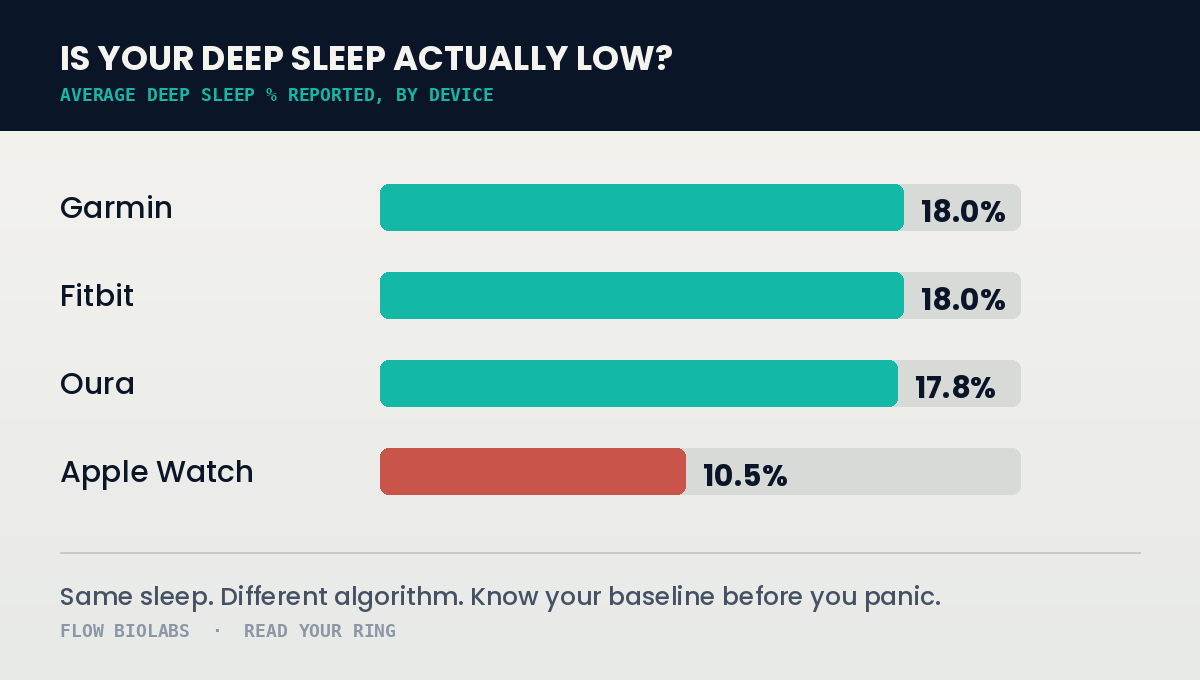
Read that again. A meaningful share of people convinced they have a deep sleep crisis are looking at an algorithm difference, not a physiology problem.
The Rebuild starts by establishing your baseline on your device, so you’re chasing a real signal instead of a rounding error. Night 1 is not a supplement. Night 1 is calibration.
Why fourteen nights, and why one lever at a time
Every sleep program you’ve tried failed for the same structural reason: it changed nine things at once, so when nothing happened you had no idea which nine things to blame.
Isolation beats stacking
Change one variable per night and the data becomes readable. You stop guessing which intervention earned its place and start knowing. By Night 14 you don’t have a routine you copied — you have a routine your own data selected.
Deep sleep is front-loaded, so the evening owns it
The majority of N3 deep sleep occurs in the first sleep cycles of the night. That means the levers that matter most are the ones you pull in the four hours before bed — thermal, light, adenosine and timing — not the ones you pull at 2am.
Fourteen nights is the shortest honest window
Night-to-night sleep variance is large enough that a three-day experiment tells you nothing. Fourteen nights gives you a seven-night baseline and a seven-night intervention block — enough signal to separate a real change from noise, short enough that you’ll actually finish it.
The fourteen levers
One per night. Cumulative — you keep the ones that work.
What you actually get
The Nightly Protocol
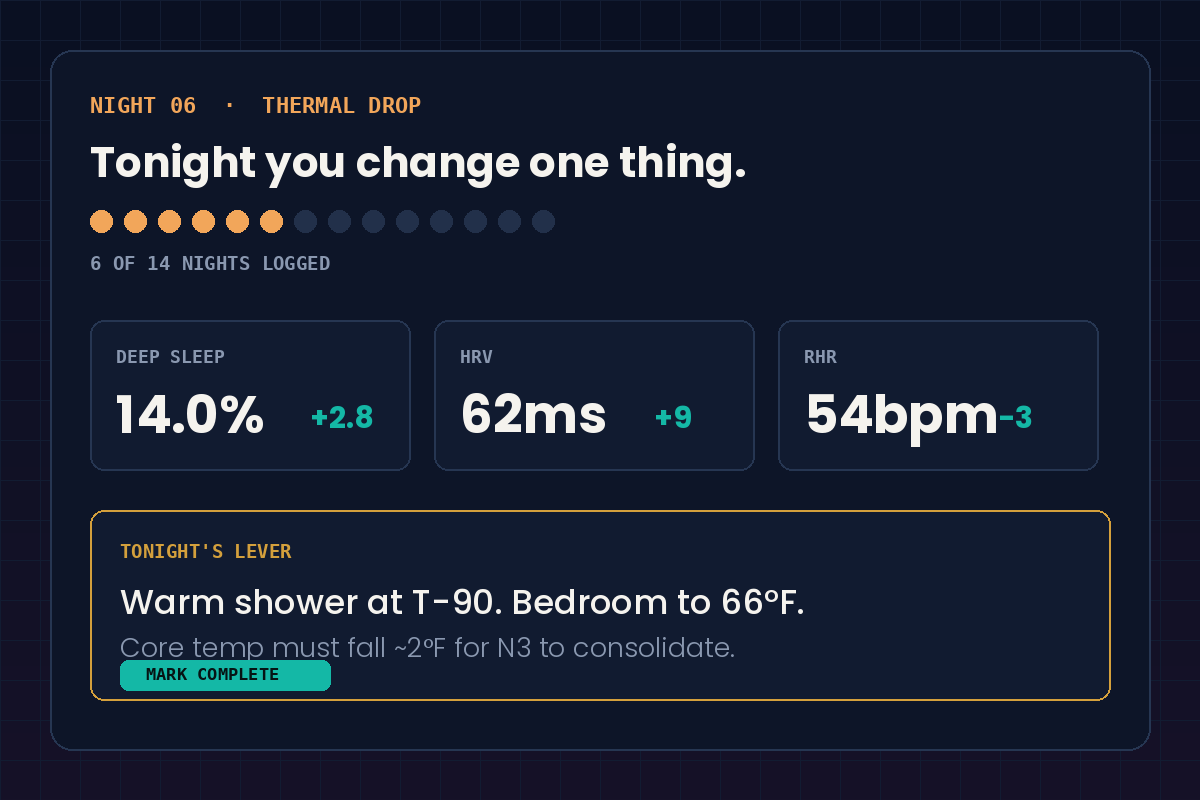
Fourteen guided nights delivered one at a time so you can’t skip ahead and stack everything on Night 2. Each night: the lever, the reason it works, the exact execution, and what to watch for in tomorrow’s data.
The Signal Scoreboard
A tracking sheet built for five metrics you already have — deep sleep %, REM %, HRV, resting heart rate, and a morning readiness score. Baseline block versus intervention block, calculated for you. This is what turns fourteen nights into an answer.
The Non-Prescription Nutrient Reference
Magnesium L-threonate, apigenin, L-theanine and glycine — what each one actually does mechanistically, typical dosing ranges found in the literature, timing relative to lights-out, and an honest section on why high-dose melatonin is the most overused tool in the category.
The Device Decoder
What Oura, Whoop, Garmin, Apple Watch and Fitbit each actually measure, where each one is known to run high or low, and how to read your own trend line instead of comparing your number to a stranger’s on Reddit.
Choose your depth
Most people take the Complete System — the protocol on its own is useful, but without the Scoreboard you’re back to guessing whether it worked.
Protocol Only
- The 14 nightly protocols
- Nutrient reference guide
- No Signal Scoreboard
- No Device Decoder
- No baseline vs. result analysis
Complete System
- The 14 nightly protocols
- Nutrient reference guide
- The Signal Scoreboard
- The Device Decoder
- Baseline vs. result analysis
- Your personal keeper stack on Night 14
The Recovery Stack
- Everything in Complete System
- Metabolic & Mitochondrial Optimization
- Functional Biomarker & Lab Interpretation
- Sequenced order of operations
Secure encrypted checkout · Instant digital delivery · One-time payment, no recurring billing
Finish fourteen nights. If your data didn’t move, you don’t pay.
Most guarantees ask you to judge a feeling. This one asks you to read a number. Complete all fourteen nights, log your Scoreboard, and if your deep sleep percentage, HRV trend or morning readiness score shows no measurable improvement over your own baseline — send the sheet to support@flowbiohealth.com within 60 days and we refund you in full. Keep the materials either way.
Straight answers
I don’t own a sleep tracker. Is this useless to me?
No. The fourteen levers work regardless of whether anything is measuring them. You’ll use the morning readiness score and sleep-onset timing instead of deep sleep percentage, which the Scoreboard is already set up for. You lose some precision, not the protocol.
Is this just going to tell me to stop drinking coffee and buy blackout curtains?
Those show up, because they work. But the value isn’t the list — it’s the sequence and the isolation. You almost certainly already “know” six of the fourteen levers and have never run a clean test on any of them. Knowing and testing are different things, and only one of them changes your data.
What if I miss a night?
You pick up where you left off. The protocol is sequenced, not scheduled — Night 9 is Night 9 whether you get to it on Tuesday or the following Sunday. Missing nights costs you time, not results.
Do I need to buy supplements?
No. Eleven of the fourteen levers cost nothing. The nutrient reference exists because people ask, and because most of what’s sold in this category is either underdosed or the wrong compound — but the protocol works without it.
Is this medical treatment for insomnia or sleep apnea?
No, and it doesn’t pretend to be. This is a structured self-experiment in behavioural and environmental sleep variables. Loud snoring, witnessed breathing pauses, gasping awakenings, or exhaustion that persists despite adequate sleep opportunity are reasons to see a licensed clinician — not reasons to try harder at a protocol.
How fast do I get access?
Immediately. Everything is delivered by email the moment your order clears, and Night 1 is designed to be started the same evening.
Sometimes low recovery isn’t behavioural.
Persistently suppressed HRV, unrefreshing sleep despite good sleep hygiene, and daytime exhaustion can reflect underlying hormonal, metabolic or respiratory issues that no evening routine will resolve. If that sounds like you, loop in your own licensed physician for lab work and a clinical evaluation, and take the free Metabolic Friction Assessment to see what else might be part of the picture.
This program is an educational self-experimentation framework. Flow BioLabs does not provide medical advice, diagnosis or treatment, and nothing here is intended to diagnose, treat, cure or prevent any disease. Consult a licensed healthcare provider before beginning any new health protocol, changing medication, or adding supplements — particularly if you are pregnant, nursing, managing a diagnosed condition, or taking prescription medication. Individual results vary. Device accuracy figures cited above are drawn from published third-party wearable validation research and reflect population averages, not guarantees about your device. © 2026 Flow BioLabs.