
This is part of Flow BioLabs’ Age Strong path — see the full guide →.
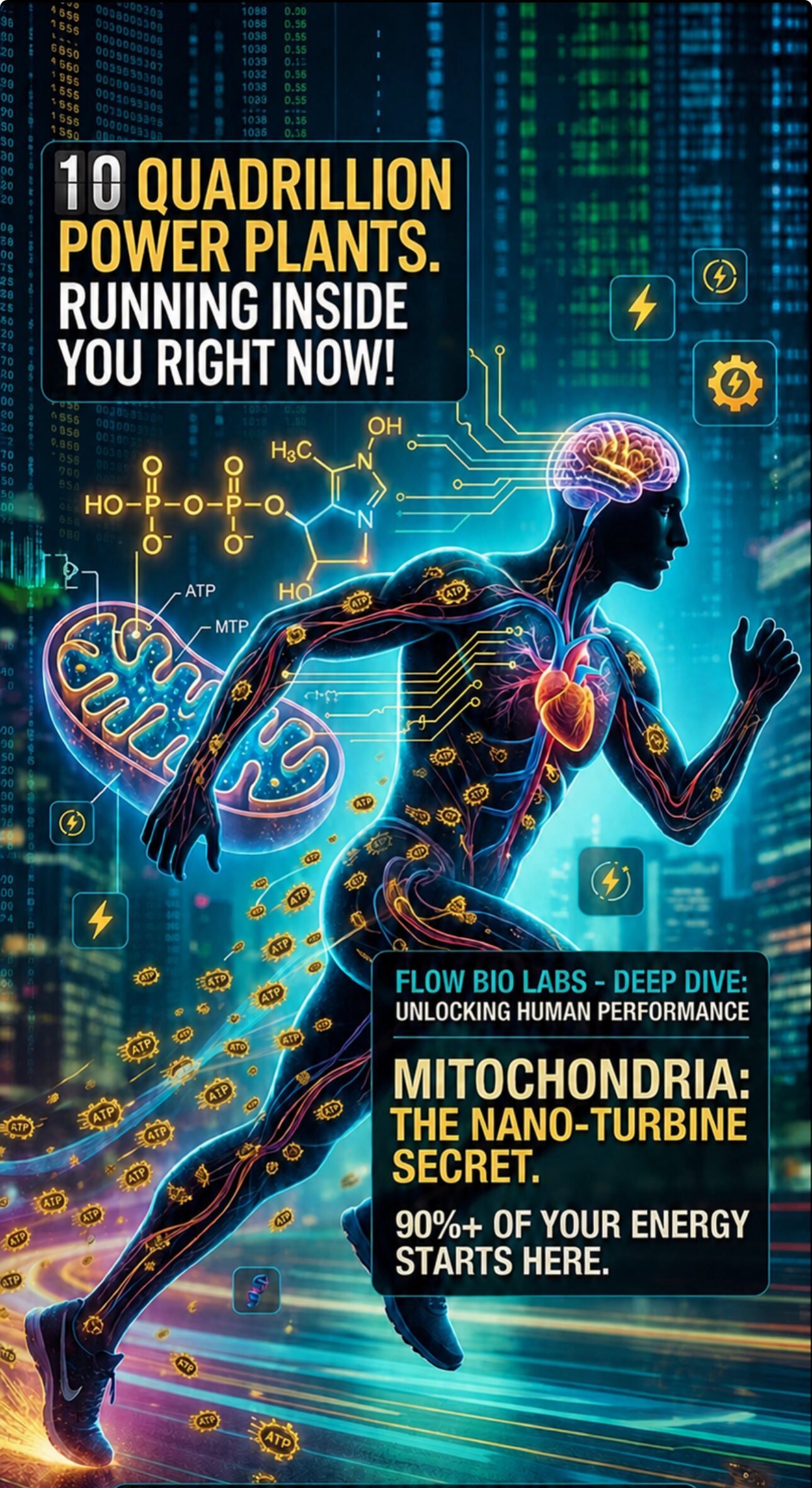
The short answer: Mitochondria are tiny structures inside almost every one of your cells that convert the food you eat and the oxygen you breathe into ATP (adenosine triphosphate) — the molecule your cells use to power everything from a heartbeat to a muscle contraction to a single thought. The study of how the body produces and uses this energy is called bioenergetics. You can meaningfully support mitochondrial function through well-established, unglamorous basics: regular aerobic exercise, resistance training, sufficient sleep, and balanced nutrition (PGC-1α: Key Regulator of Mitochondrial Biogenesis, 2025).
What Are Mitochondria?
Mitochondria are specialized structures (organelles) inside your cells, enclosed by an outer membrane and a highly folded inner membrane. Those folds, called cristae, create extra surface area for the protein complexes that drive oxidative phosphorylation — the main process responsible for generating ATP from glucose when oxygen is available (NCBI Bookshelf: Physiology, Adenosine Triphosphate).
The number of mitochondria varies widely by tissue and cell type. Energy-demanding tissues — the heart, brain, liver, and skeletal muscle — contain especially high concentrations, because these tissues have the greatest ongoing need for ATP (NIH: Mitochondria and Health). Rather than fixating on an uncertain whole-body count, the more useful takeaway is that mitochondrial function influences energy availability throughout the body.
Mitochondria do more than make ATP. They also participate in metabolic signaling (helping cells sense and respond to nutrient availability), calcium regulation, the production and management of reactive oxygen species (byproducts of energy metabolism that can be useful signals in small amounts but damaging in excess), and programmed cell death — a normal process the body uses to clear out damaged cells (National Human Genome Research Institute: Mitochondria).
Core Roles of Mitochondria
- ATP production: Supplying usable chemical energy for processes including muscle contraction, nerve signaling, ion transport, and biosynthesis (NCBI Bookshelf: Physiology, Adenosine Triphosphate).
- Metabolic signaling: Helping cells respond to nutrient availability and changing energy demands.
- Calcium regulation: Contributing to calcium balance involved in muscle and nerve function.
- Cell quality control: Participating in stress responses, mitophagy (the clearance of damaged mitochondria), and programmed cell death.
How Cells Turn Glucose Into ATP
Aerobic cellular respiration — the process of generating ATP using oxygen — is usually described in four connected stages. The exact ATP yield varies with cell conditions and the specific pathway used to move electrons into mitochondria, but a commonly cited estimate is about 30 to 32 ATP molecules per glucose molecule (NCBI Bookshelf: Physiology, Adenosine Triphosphate).
1. Glycolysis
In the cytosol (the fluid inside a cell, outside the mitochondria), one glucose molecule is split into two pyruvate molecules. Glycolysis produces a net gain of two ATP and two NADH molecules — NADH is an electron-carrying molecule used later in the process.
2. Pyruvate Oxidation
When oxygen is available, pyruvate enters the mitochondrial matrix (the innermost compartment of the mitochondrion) and is converted to acetyl-CoA, producing more NADH and releasing carbon dioxide as a byproduct.
3. The Citric Acid Cycle
Acetyl-CoA enters the citric acid cycle, also called the Krebs cycle. This cycle produces small amounts of ATP or GTP directly and loads high-energy electrons onto carrier molecules called NADH and FADH2.
4. Oxidative Phosphorylation
NADH and FADH2 deliver their electrons to protein complexes embedded in the inner mitochondrial membrane. As electrons flow through these complexes, protons get pumped into the space between the mitochondrion’s two membranes, creating an electrochemical gradient — essentially, stored potential energy. As protons flow back through a molecular machine called ATP synthase, that machine uses the gradient’s energy to build ATP. Oxygen serves as the final destination for the electrons, which is why this entire process requires oxygen (NCBI Bookshelf: Physiology, Adenosine Triphosphate).
Why Bioenergetics Matter
Bioenergetics is the study of how living systems obtain, transform, and use energy. Mitochondrial capacity is especially relevant in tissues with high or rapidly changing energy demands.
- Brain function: The brain has substantial energy requirements, and ATP supports electrical signaling, neurotransmission, and cellular maintenance (NIH: Mitochondria and Health).
- Physical performance: Skeletal muscle uses ATP for contraction. Aerobic training can increase mitochondrial content and improve muscle’s capacity to generate ATP oxidatively — a well-documented adaptation (systematic review and meta-analysis, Biomolecular Concepts, 2025).
- Recovery and adaptation: Exercise creates biochemical signals that influence mitochondrial turnover and the creation of new mitochondria (biogenesis). These adaptations occur over time and depend on training dose, recovery, nutrition, age, and health status (Pleiotropic and multi-systemic actions of physical exercise, Ageing Research Reviews, 2023).
- Cellular stress: Mitochondria both generate and respond to reactive oxygen species. Small, controlled signals can be part of normal adaptation, while excessive oxidative stress can damage cellular components (National Human Genome Research Institute: Mitochondria).
Evidence-Based Ways to Support Mitochondrial Health
Regular Aerobic Exercise
Consistent aerobic training is one of the best-supported ways to improve mitochondrial function in skeletal muscle. A 2025 systematic review and meta-analysis of randomized trials found that endurance exercise significantly increased PGC-1α — a key protein that drives the creation of new mitochondria — with both interval and continuous training producing large effects and no significant difference between the two approaches (The impact of exercise on mitochondrial biogenesis in skeletal muscle, 2025). In other words, lower-intensity steady-state sessions and higher-intensity intervals can both stimulate mitochondrial adaptation.
Progressive Resistance Training
Resistance exercise supports muscle mass, metabolic health, and functional capacity. Combining strength and aerobic work provides complementary benefits for mitochondrial and overall metabolic health (Ageing Research Reviews, 2023).
Sleep and Recovery
Training provides the signal for adaptation; recovery is when that adaptation actually happens. Adequate sleep, sensible training volume, and built-in recovery days help maintain performance and reduce the risk of accumulating fatigue over time.
Balanced Nutrition
Mitochondria use substrates derived from carbohydrates, fats, and — in some situations — amino acids. A balanced eating pattern that provides adequate energy, protein, micronutrients, and hydration supports the systems involved in energy metabolism. Extreme fasting or supplement protocols are not required for most people and may be inappropriate for some.
The Bottom Line
Mitochondria are not a trendy shortcut; they’re fundamental to human biology. Supporting them starts with the basics: regular movement, progressive training, sufficient sleep, balanced nutrition, and medical guidance when symptoms or health conditions warrant it.
Understanding bioenergetics gives you a clearer lens for interpreting fatigue, performance, and recovery — without turning a complex cellular system into hype.
Frequently Asked Questions
What do mitochondria actually do?
Mitochondria convert nutrients and oxygen into ATP, the molecule your cells use for energy. They also help regulate calcium levels, manage reactive oxygen species, and participate in programmed cell death and quality-control processes (National Human Genome Research Institute: Mitochondria).
How many mitochondria does the body have?
The exact number varies enormously by tissue and individual, so a precise whole-body figure isn’t a meaningful metric. What matters more is that energy-demanding tissues like the heart, brain, and skeletal muscle have especially high mitochondrial density (NIH: Mitochondria and Health).
Can exercise increase the number of mitochondria in my cells?
Yes. Aerobic exercise is one of the most well-supported ways to stimulate mitochondrial biogenesis (the creation of new mitochondria) in skeletal muscle, primarily through a signaling protein called PGC-1α. This effect has been confirmed in a 2025 systematic review and meta-analysis of randomized trials (Biomolecular Concepts, 2025).
What is ATP and why does it matter?
ATP (adenosine triphosphate) is the primary molecule cells use to store and transfer usable energy. It powers processes ranging from muscle contraction and nerve signaling to protein synthesis (NCBI Bookshelf: Physiology, Adenosine Triphosphate).
What’s the best way to support mitochondrial health?
The best-supported strategies are consistent aerobic exercise, resistance training, adequate sleep, and balanced nutrition. These fundamentals have more robust evidence behind them than any supplement or peptide protocol currently marketed for “mitochondrial support.”
Educational Disclaimer
This article is for educational purposes only and is not medical advice. Consult a qualified healthcare professional before changing your exercise, diet, supplement, or treatment plan. If you have symptoms of fatigue or reduced energy that concern you, take the free Metabolic Friction Assessment to see where those signals are coming from, then bring the results to a licensed provider.
Sources and Further Reading
- National Human Genome Research Institute: Mitochondria
- National Institutes of Health: Mitochondria and Health
- NCBI Bookshelf: Physiology, Adenosine Triphosphate
- The impact of exercise on mitochondrial biogenesis in skeletal muscle: A systematic review and meta-analysis of randomized trials (2025)
- Pleiotropic and multi-systemic actions of physical exercise on PGC-1α signaling, Ageing Research Reviews (2023)
- PGC-1α: key regulator of mitochondrial biogenesis (2025)
Looking for a different angle? Our Recover & Perform path — see the full guide → — may also be relevant.
Want to go deeper? The Flow BioLabs Recovery Stack is all three systems in sequence: Deep Sleep Rebuild, Metabolic & Mitochondrial Optimization, and Lab Interpretation. See the program →