Every second, your immune system is on patrol. Specialized white blood cells called T cells constantly scan the body for infected, damaged, or cancerous cells and destroy them before they can turn into a serious threat. So why do some cancers—and chronic viral infections like HIV—manage to keep growing despite this powerful defense system?
This is part of Flow BioLabs’ Age Strong path — see the full guide →.
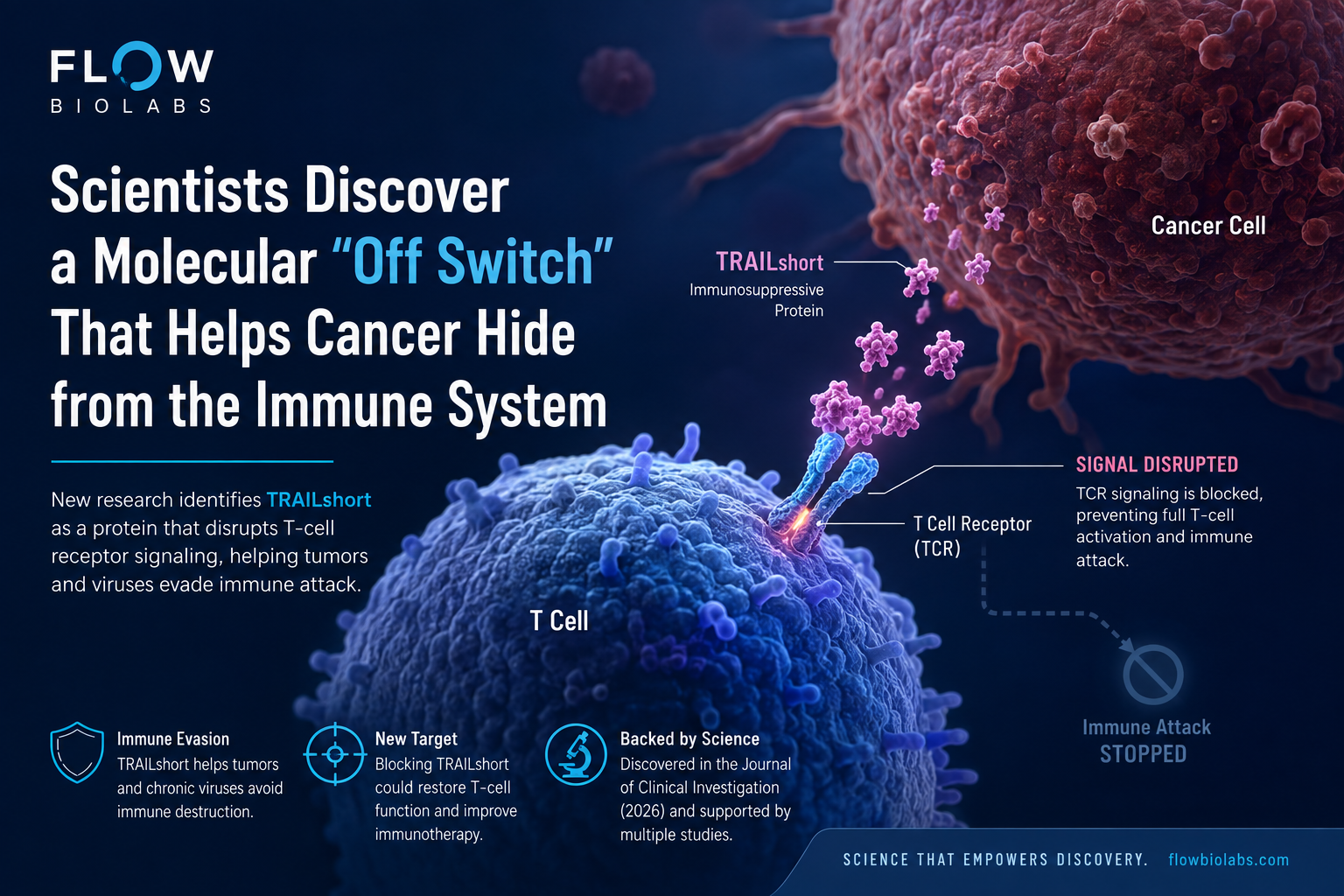
A team at Mayo Clinic may have uncovered part of the answer. In a study published August 3, 2026 in the Journal of Clinical Investigation, researchers identified a protein called TRAILshort that acts like a molecular “off switch” for T cells—directly interfering with the internal signals a T cell needs to recognize and attack a dangerous target (Jalali et al., J Clin Invest, 2026). This is a basic-science discovery made in cells and mice, not a new treatment—but it helps explain a long-standing mystery in cancer immunology and points to a promising target for future drugs.
How Cancer May Be Switching Off Your Immune Response
T cells find their targets using a structure on their surface called the T-cell receptor (TCR)—the sensor that lets a T cell recognize a fragment of an abnormal or foreign protein displayed on another cell’s surface. When the receptor engages, it triggers a cascade of internal signals that spurs the T cell into action: multiplying, releasing inflammatory messengers, and killing the target cell.
Researchers had known for years that TRAILshort—a truncated variant of a protein called TRAIL—showed up at elevated levels in HIV-infected cells and in roughly 40% of human tumors, but what it was doing there wasn’t well understood (Ou et al., Clinical Cancer Research, 2020). The new study shows TRAILshort binds a receptor called DR5 on T cells and recruits an enzyme called SHP-1, a phosphatase that acts like a biochemical brake. SHP-1 then strips phosphate groups off two relay proteins, ZAP-70 and its docking partner CD3ζ (CD3-zeta), among the first dominoes to fall when a T-cell receptor is triggered (Jalali et al., 2026). With that relay disrupted, the T cell doesn’t die or disappear—it simply fails to respond with full force, producing less of the cytokines and killing activity needed to clear the threat. In lab experiments, blocking SHP-1 restored much of that lost function, suggesting the effect is a switch that can potentially be flipped back rather than permanent damage (Jalali et al., 2026).
A Strategy Used by Many Tumors—and a New Twist for CAR-T Therapy
This discovery builds on earlier work showing that up to 40% of human tumors express TRAILshort, including melanoma, lung, breast, pancreatic, and ovarian cancers, as well as Hodgkin lymphoma, and that blocking TRAILshort in the lab increased immune-cell killing of cancer cells in cell cultures and animal models (Ou et al., Clinical Cancer Research, 2020). The new JCI study adds a striking real-world wrinkle: in mice engineered with human immune systems, tumor cells producing TRAILshort measurably blunted the effectiveness of CAR-T cell therapy—an approved cancer treatment in which a patient’s own T cells are engineered to hunt down cancer cells (Jalali et al., 2026). TRAILshort may be one reason some patients don’t respond as well as expected to cutting-edge cellular immunotherapies already used in clinics today.
The researchers also found elevated TRAILshort activity linked to a strikingly wide range of conditions where the immune system struggles—including COVID-19, tuberculosis, hepatitis C, lupus, and Crohn’s disease, in addition to cancer and HIV (Jalali et al., 2026; Mayo Clinic, 2026). “TRAILshort appears in cancer, HIV, COVID-19, tuberculosis, lupus and Crohn’s disease—almost every condition where the immune system is failing or misfiring,” said senior author Andrew Badley, M.D. “That tells us we may have identified a fundamental switch in human immunity, not just a curiosity in one disease” (Mayo Clinic, 2026).
Why This Matters for Cancer Immunotherapy
Modern cancer immunotherapies, including immune checkpoint inhibitors, work by releasing built-in brakes that stop T cells from attacking the body’s own tissue—brakes that tumors often hijack to protect themselves. The National Cancer Institute explains that checkpoint proteins on T cells normally bind partner proteins on other cells to send an “off” signal, and that many tumors exploit this system (for example, by producing large amounts of a checkpoint protein called PD-L1) to avoid destruction; checkpoint-inhibitor drugs work by blocking that handshake so T cells stay switched on (National Cancer Institute). These drugs have transformed treatment for cancers like melanoma and lung cancer, but many patients still don’t respond, or their tumors eventually develop resistance.
TRAILshort appears to be a distinct, previously unrecognized checkpoint-like pathway—one that acts earlier and more directly on the T-cell receptor’s internal wiring, rather than through the well-known PD-1/PD-L1 or CTLA-4 routes. By pinpointing how TRAILshort suppresses T-cell activation, the Mayo Clinic team identified a defined molecular target: antibodies engineered against TRAILshort’s unique tail region (found in no other known human protein) could, in principle, neutralize it without triggering the broader side effects of some existing immune-boosting drugs, and could eventually be paired with CAR-T cells, checkpoint inhibitors, or therapeutic vaccines (Jalali et al., 2026).
The researchers also see potential value in the opposite direction. Because TRAILshort dials T cells down rather than killing them, delivering more of it in controlled settings might one day help calm an overactive immune system in autoimmune disease or organ transplantation, without the blanket immune suppression current drugs require. “In cancer, there’s too much TRAILshort, so our goal is to get rid of it with antibodies that remove it. In autoimmune disease, there’s not enough TRAILshort, so our goal is to deliver more,” Badley said (Mayo Clinic, 2026).
What This Discovery Does—and Doesn’t—Mean Right Now
It’s worth being direct about the stage this research is at. This is basic, preclinical science—findings from human cells in the lab and mice engineered with human immune systems, not from clinical trials in patients (Jalali et al., 2026). The study’s own authors note real limitations: a pharmacological SHP-1 inhibitor only partially reversed TRAILshort’s effects, and removing TRAILshort from tumor cells in mice delayed but didn’t eliminate tumor growth, since cancer cells rely on many other survival pathways too (Jalali et al., 2026). There is no TRAILshort-blocking drug approved or in human trials yet, and this discovery doesn’t translate into a supplement, lifestyle change, or “immune-boosting” action to take today. Its real significance is narrower and more useful: it gives researchers a clearly defined molecular target and a plausible explanation for a phenomenon—immune evasion and immunotherapy resistance—that doctors have observed clinically for years without fully understanding. Checkpoint inhibitors themselves took decades to move from basic T-cell biology discoveries to approved drugs (National Cancer Institute); TRAILshort is a promising early lead, not a finished therapy.
FAQ
What is TRAILshort?
TRAILshort is a naturally occurring, truncated variant of a protein called TRAIL. Unlike full-length TRAIL, it cannot trigger cell death directly. Instead, researchers found it binds a receptor called DR5 on T cells and activates an internal “brake” (the enzyme SHP-1) that weakens the T cell’s ability to respond to threats (Jalali et al., J Clin Invest, 2026).
Does this mean there’s a new cancer treatment available?
No. This is early, preclinical research conducted in human cells and in mice with engineered human immune systems, not a treatment tested in people. Any drug that targets TRAILshort would still need to go through years of development and clinical trials before it could be considered for patients (Jalali et al., 2026).
How is TRAILshort different from existing immune checkpoints like PD-1?
PD-1 and CTLA-4, the targets of current checkpoint-inhibitor drugs, work by binding partner proteins that send an “off” signal to T cells from the outside (National Cancer Institute). TRAILshort appears to act more directly on the internal signaling machinery a T cell uses right after it detects a target, suggesting it’s a distinct suppressive pathway that could complement, rather than replace, existing checkpoint therapies (Jalali et al., 2026).
Why does this matter beyond cancer?
Researchers found elevated TRAILshort activity linked to a wide range of conditions marked by immune dysfunction, including HIV, COVID-19, tuberculosis, hepatitis C, lupus, and Crohn’s disease (Jalali et al., 2026; Mayo Clinic, 2026). That breadth suggests TRAILshort could eventually be relevant to both boosting immunity against cancer and infection, and calming it in autoimmune disease and transplantation—though both applications remain in early research stages.
References
Jalali S, et al. TRAIL splice variant TRAILshort disrupts T cell receptor signaling and promotes immune tolerance in vivo. Journal of Clinical Investigation. 2026;136(15):e194449. DOI: 10.1172/JCI194449.
Ou J, et al. Human cancers express TRAILshort, a dominant negative TRAIL splice variant, which impairs immune effector cell killing of tumor cells. Clinical Cancer Research. 2020;26(21):5759-5771. (PubMed Central)
Sheu B-C, et al. Association of TRAIL receptor with phosphatase SHP-1 enables repressing T cell receptor signaling and T cell activation through inactivating Lck. Journal of Biomedical Science. 2024. (PubMed Central)
National Cancer Institute. Immune Checkpoint Inhibitors. (cancer.gov)
Mayo Clinic. Researchers discover immune ‘off switch’ used by cancer cells. 2026. (Medical Xpress)
Want to go deeper? The Flow BioLabs Recovery Stack is all three systems in sequence: Deep Sleep Rebuild, Metabolic & Mitochondrial Optimization, and Lab Interpretation. See the program →