
This is part of Flow BioLabs’ Feel Better Now path — see the full guide →.
The Short Answer
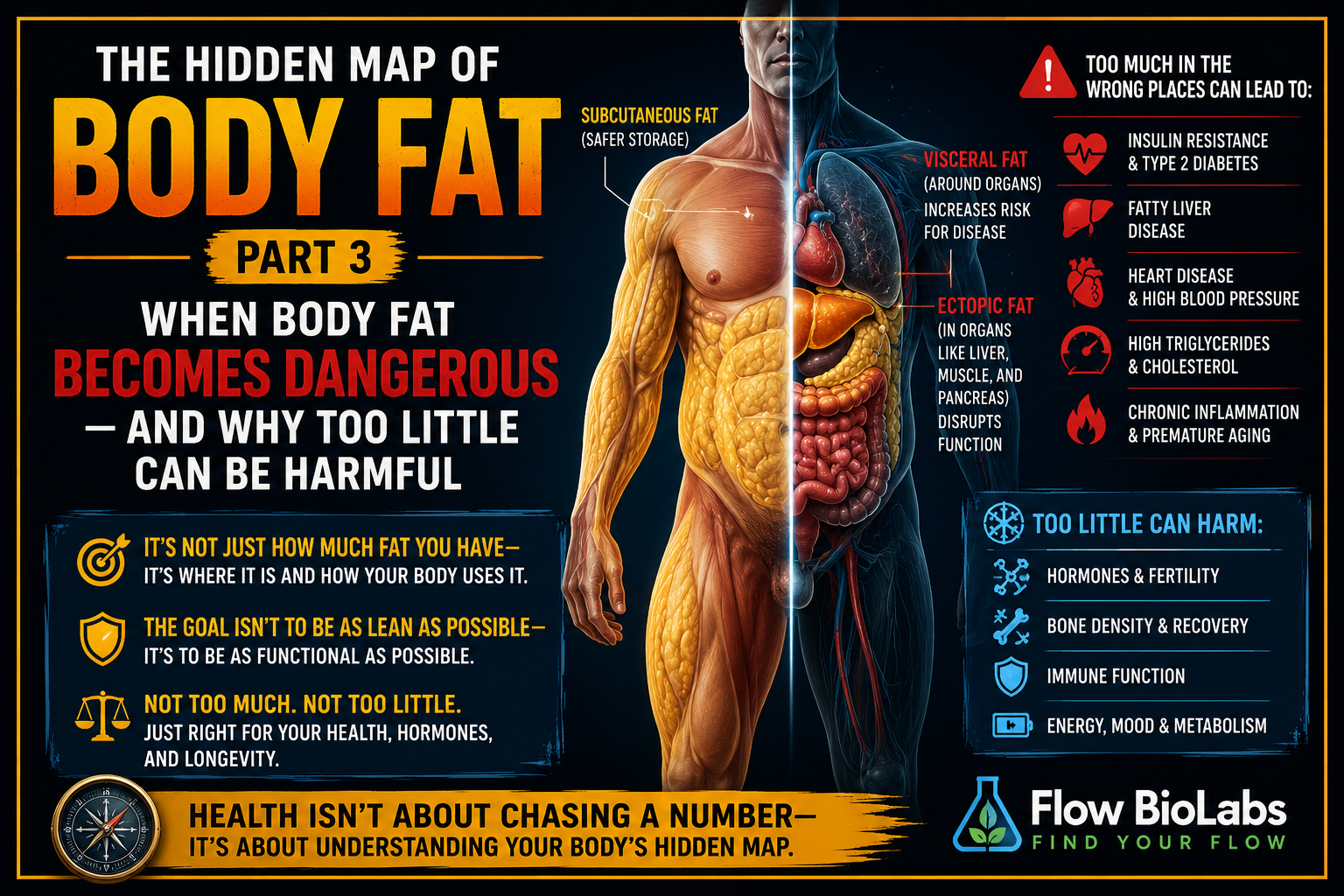
Body fat itself isn’t dangerous — dysfunctional fat storage is. When fat is stored safely under the skin (subcutaneously) and fat cells remain responsive to insulin, the system works well even at relatively high total amounts. Problems begin when the body runs out of safe storage space and excess energy spills into the abdomen (visceral fat) or directly into organs like the liver, muscle, and pancreas (ectopic fat), where it disrupts normal function and drives insulin resistance, inflammation, and cardiovascular risk (Ectopic Fat and Insulin Resistance, 2012). At the same time, having too little stored energy is its own health risk — the body needs a baseline of fat and steady energy availability to keep hormones, bones, and immune function working normally. Healthy body composition is about balance, not extremes.
Key Takeaways
- Fat becomes a health risk primarily when storage location and function break down—not simply based on the total amount present.
- Subcutaneous fat is generally the body’s safer storage compartment; visceral and ectopic fat carry substantially higher metabolic risk.
- The adipose-tissue expandability hypothesis explains why some people develop metabolic problems at lower body-fat levels than others.
- “Metabolically healthy obesity” describes a temporary pattern, not a guarantee of long-term safety.
- BMI is a useful population-level screening tool but cannot distinguish fat from muscle or visceral fat from subcutaneous fat.
- Too little body fat—or chronically low energy availability—can disrupt reproductive hormones, bone health, thyroid function, and immunity.
- Sex differences in fat distribution and essential fat requirements mean risk thresholds differ between men and women.
Body Fat Is Not the Enemy — Dysfunctional Storage Is
For decades, body fat was treated as simple, unwanted weight: more was worse, less was better, and leaner was assumed to mean healthier. Human biology is more interconnected than that. As covered in Parts 1 and 2, fat tissue is an active organ system that stores energy, cushions structures, helps regulate temperature, and produces hormones involved in appetite, reproduction, immunity, and glucose regulation (Endotext, adipose tissue physiology).
So the more useful question isn’t simply “how much fat does this person have?” It’s a cluster of more specific questions: Where is the fat being stored? Can the tissue continue storing energy safely? Has fat begun collecting around or inside vital organs? Is the tissue inflamed or insulin-resistant? And on the other end of the spectrum — has available energy fallen too low to support normal function? Two people can have similar body weights or body-fat percentages while carrying very different metabolic risks, because the answers to these questions differ.
The Body Needs a Safe Place to Store Excess Energy
After a meal, the body has to decide what to do with incoming energy. Some is used immediately; some is stored as glycogen (a storage form of carbohydrate) in the liver and muscles. When intake exceeds immediate needs and glycogen capacity, the remaining energy is generally stored as triglycerides inside fat cells — ideally in subcutaneous adipose tissue, the softer fat located beneath the skin.
Healthy subcutaneous fat functions like a well-designed storage warehouse: existing fat cells enlarge, and under favorable conditions, the body creates new fat cells to distribute the load. This keeps large amounts of fat from being deposited in organs never designed for long-term fuel storage. One influential framework here is the adipose-tissue expandability hypothesis, which proposes that metabolic problems become more likely once subcutaneous fat can no longer expand or create new storage capacity efficiently (Janssen, 2024, International Journal of Molecular Sciences). When that happens, existing fat cells become enlarged and stressed, and excess energy begins spilling into visceral and ectopic locations such as the liver and skeletal muscle. The problem isn’t that storage exists — it’s that storage has moved somewhere dangerous.
Subcutaneous Fat: Usually the Safer Storage Compartment
Subcutaneous fat — the fat you can pinch around the abdomen, hips, thighs, arms, or buttocks — is generally considered a safer storage location than visceral or organ fat, though excessive amounts can still create mobility and joint problems. Lower-body subcutaneous fat, particularly around the hips and thighs, may be especially effective at holding fatty acids away from the liver and other vulnerable tissues.
Fat distribution differs between individuals and is influenced by sex hormones, genetics, age, ancestry, menopause, medications, sleep, and activity level. That doesn’t mean unlimited subcutaneous fat is harmless — as total body mass rises, people may experience greater stress on joints, reduced mobility, worsening sleep apnea, and a growing likelihood that safe storage capacity will eventually become overwhelmed. Subcutaneous fat is better described as less metabolically dangerous, not automatically harmless (Pedley et al., 2013, JACC Cardiovascular Imaging).
Visceral Fat: The Hidden Fat Around the Organs
Visceral fat is stored inside the abdominal cavity, surrounding organs such as the liver and intestines. Unlike the soft fat directly beneath the skin, visceral fat can produce a firm or enlarged abdomen even when relatively little fat can be pinched at the surface.
Visceral tissue is biologically active: it releases fatty acids and signaling molecules and is strongly associated with insulin resistance, abnormal blood lipids, hypertension, type 2 diabetes, fatty liver disease, cardiovascular disease, and premature mortality (Visceral adipose tissue and residual cardiovascular risk, 2023, PMC). One likely anatomical reason: blood draining from portions of the visceral region travels toward the liver through the portal circulation, exposing the liver to a larger flow of fatty acids and inflammatory signals, which can contribute to excess liver-fat storage, altered lipid production, and impaired insulin action.
Visceral fat shouldn’t be viewed as a single evil substance acting alone — it’s often part of a broader pattern involving impaired subcutaneous storage, excess energy availability, inactivity, muscle loss, genetics, poor sleep, hormonal changes, and ectopic-fat accumulation. But as warning signs go, excess visceral fat deserves attention.
Ectopic Fat: When Energy Invades the Wrong Tissue
Ectopic fat means fat stored in locations not intended to serve as major long-term storage depots — including the liver, pancreas, skeletal muscles, heart, kidneys, and blood vessels. Small amounts of lipid inside certain tissues can be normal and useful; the danger isn’t that a single fat molecule entered an organ, but that excessive or dysfunctional accumulation occurs. When more fatty acids enter a tissue than it can safely burn, package, or export, harmful lipid byproducts and cellular stress can interfere with insulin signaling and normal organ function (Ectopic Fat and Insulin Resistance, 2012).
Fat in the Liver
The liver normally processes and redistributes energy. When too much fat accumulates there, metabolic dysfunction-associated steatotic liver disease (MASLD) can develop. Liver fat is closely linked to insulin resistance, elevated triglycerides, abnormal glucose regulation, and increased glucose production by the liver. Some people progress from simple fat accumulation to inflammation, fibrosis, cirrhosis, or liver-related complications. Importantly, fatty liver can occur in people who don’t appear severely overweight — body size alone can’t reveal what’s happening inside the liver (Gill & Sattar, 2014, BMC Medicine).
Fat in Skeletal Muscle
Muscle cells use fatty acids as fuel, particularly during prolonged activity, so fat inside muscle isn’t always harmful. Well-trained endurance athletes can carry relatively high levels of intramuscular fat while remaining highly insulin-sensitive — sometimes called the “athlete’s paradox.” The key difference appears to be the muscle’s ability to rapidly store, access, and burn the fat. In inactive or insulin-resistant muscle, excess lipid byproducts may accumulate and disrupt insulin signaling. The issue isn’t merely the presence of fat, but whether the tissue can manage it properly (Lara-Castro & Garvey, 2008, Endocrinology and Metabolism Clinics of North America).
Fat in the Pancreas
Fat can also accumulate within and around the pancreas. Researchers are still working to determine exactly when pancreatic fat contributes directly to beta-cell dysfunction (impaired function of the insulin-producing cells) and when it mainly reflects broader metabolic problems. Greater pancreatic fat has been associated with a higher risk of type 2 diabetes, although an association doesn’t prove that pancreatic fat alone caused the disease (Fatty Pancreas and Cardiometabolic Risk, 2022).
Fat Around the Heart
Fat located around the heart can serve normal protective and energy-supplying roles. In excess, certain cardiac fat deposits may be associated with inflammation, coronary artery disease, abnormal heart structure, and impaired function (Ectopic Fat Accumulation in Pancreas and Heart, 2021). The overall lesson: fat is safest inside healthy fat tissue. When excess energy accumulates inside the body’s machinery instead, metabolic risk rises.
Fat-Cell Size Matters — But So Does Fat-Cell Health
A person doesn’t gain body fat merely by filling a fixed number of cells. Fat tissue expands two ways: hypertrophy (existing fat cells enlarge) and hyperplasia (new fat cells are created). Both are normal. However, fat tissue that expands mainly through extreme enlargement of existing cells is more likely to develop poor blood flow, cellular stress, fibrosis, inflammation, and impaired insulin responsiveness (Kahn, Wang & Lee, 2019, Journal of Clinical Investigation).
An enlarged, dysfunctional fat cell may release fatty acids too readily and respond poorly to insulin’s signal to stop releasing stored energy. That creates a strange metabolic condition: the body may have enormous energy reserves, yet those reserves aren’t controlled properly, and fat continually enters the bloodstream even when it isn’t needed. This helps explain why two people with the same BMI can have very different blood-sugar levels, liver-fat burdens, and cardiovascular risks — it isn’t only fat quantity, but also fat-cell size, storage location, tissue blood supply, inflammation, insulin sensitivity, and muscle mass.
Metabolically Healthy Obesity: Healthy — or Temporarily Protected?
Some people with obesity maintain relatively normal blood pressure, blood sugar, blood lipids, and liver function for a period of time — a pattern sometimes called “metabolically healthy obesity.” The term can be misleading: it doesn’t mean higher body fat can never create risk, only that a person currently shows fewer measurable metabolic abnormalities than expected (Metabolically Healthy Obesity, 2020, Endocrine Reviews).
People fitting this pattern may have greater capacity to store fat subcutaneously, less visceral or liver fat, smaller and more insulin-sensitive fat cells, more muscle mass, and favorable genetics or activity patterns. However, metabolic health can change with age, weight gain, menopause, declining activity, muscle loss, illness, or further fat-tissue expansion. A recent narrative review argues the field is shifting away from “metabolically healthy obesity” as a stable category, toward distinguishing preclinical obesity (preserved organ function) from clinical obesity involving organ dysfunction (Does metabolically healthy obesity really exist, 2026 review). The takeaway isn’t that body weight is irrelevant — it’s that body weight is an incomplete measurement. A scale can’t tell you whether fat is safely stored beneath the skin or accumulating inside the liver.
Why BMI Cannot Show the Entire Risk Picture
BMI (body mass index) compares weight with height. It’s useful for examining health patterns across large populations, but it cannot directly distinguish fat from muscle, visceral fat from subcutaneous fat, liver fat from healthy tissue, or a large-framed person from a small-framed one. That doesn’t make BMI useless — it makes BMI one clue, not a diagnosis.
Waist circumference can add information because increasing abdominal size often reflects some combination of visceral and subcutaneous abdominal fat, though risk thresholds differ by sex, ancestry, age, and body build, so a single universal cutoff shouldn’t be treated as a rigid boundary between safe and unsafe. The most useful picture typically combines weight trend, waist trend, blood pressure, fasting glucose or A1C, triglycerides and HDL cholesterol, liver enzymes, family history, sleep quality, activity level, strength, and imaging when medically appropriate. No single number tells the whole story.
When Body Fat Becomes Too Low
The health conversation often stops after discussing excess fat — that’s a mistake. The human body needs a minimum amount of stored energy and a steady supply of dietary energy to maintain normal physiological function. “Too low” can’t be defined by one universal body-fat percentage; different people experience problems at different levels depending on sex, genetics, age, hormone status, training volume, calorie intake, and rate of weight loss.
Importantly, many problems attributed to extremely low body fat are actually related to low energy availability — the dietary energy left for the body’s basic functions after exercise expenditure is subtracted. A person can experience low energy availability even without reaching an exceptionally low body-fat percentage. If too little energy remains after training and daily activity, the body conserves resources by cutting funding to systems that aren’t immediately necessary for survival — reproductive hormones, thyroid-related signaling, bone remodeling, immune function, and recovery may all be affected. This clinical pattern is now formally described as Relative Energy Deficiency in Sport, or RED-S (Relative Energy Deficiency in Sport (RED-S), 2022, PMC). The body isn’t malfunctioning; it’s rationing fuel.
Possible Effects of Excessive Leanness or Chronic Undereating
Reproductive and Sex-Hormone Disruption
Women may experience irregular or absent menstrual periods, reduced estrogen signaling, fertility difficulties, or changes in libido. Men may experience reduced testosterone, lower libido, impaired reproductive function, or diminished morning erections. These problems aren’t limited to professional athletes — they can occur in anyone combining heavy activity with inadequate nutrition (Beyond Menstrual Dysfunction: Altered Endocrine Function in RED-S, 2024).
Bone Loss and Stress Injuries
Bone is living tissue that’s constantly being broken down and rebuilt. Low energy availability can reduce bone formation and alter the reproductive and metabolic hormones that normally protect skeletal health, potentially contributing to lower bone density and a greater risk of stress fractures over time.
Reduced Thyroid-Related Activity
During prolonged energy restriction, the body may reduce active thyroid-hormone signaling as an energy-conservation response, which can contribute to feeling unusually cold, fatigue, slower movement, reduced spontaneous activity, poor concentration, and lower training performance. This doesn’t necessarily mean the thyroid gland itself is diseased — it may reflect the body adapting to inadequate available fuel.
Poor Recovery and Loss of Lean Tissue
When calories and protein are inadequate, the body may struggle to repair muscle and connective tissue. Training harder under these circumstances doesn’t force better results — it often digs the hole deeper.
Immune and Mood Changes
Persistent under-fueling may coincide with more frequent illness, poor sleep, irritability, anxiety, depressed mood, food preoccupation, or reduced concentration. These symptoms have many possible causes, so they shouldn’t be self-diagnosed as a body-fat problem — but when they appear alongside aggressive dieting, rapid weight loss, compulsive exercise, or menstrual and libido changes, they deserve attention.
Women and Men Do Not Have Identical Fat Requirements
Women naturally carry a higher proportion of essential and reproductive fat than men — not a flaw or a failure of discipline. Female fat distribution and energy reserves help support estrogen production, menstrual function, pregnancy, lactation, fetal development, and bone health. Before menopause, estrogen generally favors more lower-body subcutaneous storage and less visceral accumulation; after menopause, declining estrogen is often accompanied by a shift toward greater abdominal and visceral fat storage.
Men usually carry less total body fat but tend to accumulate a larger proportion in the abdomen and visceral compartment, meaning a man with a moderate amount of total body fat may still carry considerable metabolic risk if much of it is visceral. Neither sex receives a free pass: women can develop visceral and ectopic fat, and men can experience hormonal and bone consequences from excessive leanness or under-fueling. The patterns differ, but the underlying rule is the same — the body needs enough energy to function and safe places to store the excess.
Warning Signs That Fat Storage May Be Becoming Unhealthy
Body appearance alone can’t diagnose metabolic disease, but certain patterns deserve medical attention:
- A rapidly expanding waistline
- Unexplained or rapid weight gain
- Elevated fasting glucose or A1C
- High triglycerides or low HDL cholesterol
- Rising blood pressure
- Abnormal liver enzymes or diagnosed fatty liver
- Sleep apnea symptoms
- Darkened, velvety skin around the neck or underarms
- Severe fatigue after meals
- A strong family history of type 2 diabetes or early cardiovascular disease
These signs don’t prove that visceral or ectopic fat is the cause — they indicate that the metabolic system should be evaluated.
Warning Signs That Energy Availability May Be Too Low
Seek professional guidance when aggressive dieting or high training volume is accompanied by:
- Missed or irregular menstrual cycles
- Falling libido
- Persistent fatigue or declining strength/athletic performance
- Repeated stress fractures or unexplained bone injuries
- Feeling cold most of the time
- Poor sleep or frequent illness
- Slow wound healing
- Dizziness, fainting, or hair loss
- Food obsession or compulsive exercise
- Rapid, unintended, or extreme weight loss
Chest pain, fainting, confusion, severe weakness, a very slow or irregular heartbeat, or symptoms of a serious eating disorder require prompt medical attention. This article is educational and cannot determine whether a person’s symptoms come from body fat, nutrition, hormones, medication, illness, or another cause.
The Goal Is Not Maximum Thinness
The healthiest body isn’t necessarily the one with the lowest number on a scale, nor automatically the one with the most visible abdominal muscles. A person can look lean while carrying liver fat, having little muscle, sleeping poorly, or experiencing low energy availability. Another person can carry visible subcutaneous fat while maintaining strong muscles, good insulin sensitivity, normal blood pressure, and healthy lab markers. Health exists in function, not just appearance.
A more useful goal is a body with enough fat to support normal hormones and physiology, enough subcutaneous capacity to store energy safely, limited visceral and ectopic fat, sufficient muscle mass, good insulin sensitivity, stable energy and appetite, strong bones, and healthy blood pressure and lab markers. That’s a very different goal from simply trying to become smaller.
The Hidden Map Matters More Than the Scale
Body fat isn’t one substance stored in one uniform container — it’s a collection of tissues occupying different locations, performing different jobs, and carrying different levels of risk. Subcutaneous fat is usually the body’s safer energy warehouse. Visceral fat is a warning that storage is shifting toward a more metabolically active abdominal compartment. Ectopic fat is evidence that energy is entering tissues and organs not designed to serve as large storage depots. And extremely low body fat — or chronically inadequate energy availability — can force the body to reduce spending on reproduction, bones, hormones, immunity, repair, and performance.
The goal isn’t to eliminate fat. It’s to preserve a storage system that works — because when fat stays in the right place and remains responsive to the body’s signals, it helps protect health. When storage capacity fails, or energy reserves become dangerously depleted, the entire system begins paying the price.
Frequently Asked Questions
Is visceral fat more dangerous than subcutaneous fat?
Yes, generally. Visceral fat is more metabolically active and is strongly linked to insulin resistance, fatty liver disease, and cardiovascular disease, while subcutaneous fat is typically a safer storage compartment (Visceral adipose tissue and residual cardiovascular risk, 2023).
Can you have a normal weight and still have unhealthy fat storage?
Yes. Normal-weight individuals can carry excess visceral fat and face elevated metabolic risk despite a healthy BMI, a pattern sometimes described as “skinny fat” or normal-weight obesity (BMJ Open, 2017).
What is metabolically healthy obesity?
It describes people with obesity who currently show few measurable metabolic abnormalities, such as normal blood pressure and blood sugar. It’s considered a potentially temporary state rather than a guarantee of long-term safety, since metabolic health can shift with age, weight change, or reduced activity (Metabolically Healthy Obesity, 2020).
Can having too little body fat be unhealthy?
Yes. Very low body fat or chronic low energy availability can disrupt reproductive hormones, thyroid function, bone density, and immune health — a pattern known as Relative Energy Deficiency in Sport (RED-S) (RED-S review, 2022).
Is BMI a reliable way to measure health risk?
BMI is useful for population-level screening but can’t distinguish fat from muscle or visceral fat from subcutaneous fat. It works best alongside waist circumference, blood markers, and other health indicators rather than as a standalone diagnosis.
Coming in Part 4
Part 4 covers how to reduce harmful fat without harming metabolism: why whole-body fat loss beats spot reduction, why visceral fat may respond faster than some subcutaneous fat, how resistance training protects muscle during weight loss, and how sleep, alcohol, stress, protein, and fiber all influence fat distribution. The answer isn’t punishment — it’s giving the body a reason to use stored energy while protecting the muscle, hormones, and health you’re trying to improve.
Want to go deeper? The 21-Day Metabolic Friction Reset is a day-by-day, 21-day plan for removing the everyday friction behind stalled progress. See the program →