
This is part of Flow BioLabs’ Feel Better Now path — see the full guide →.
The Short Answer
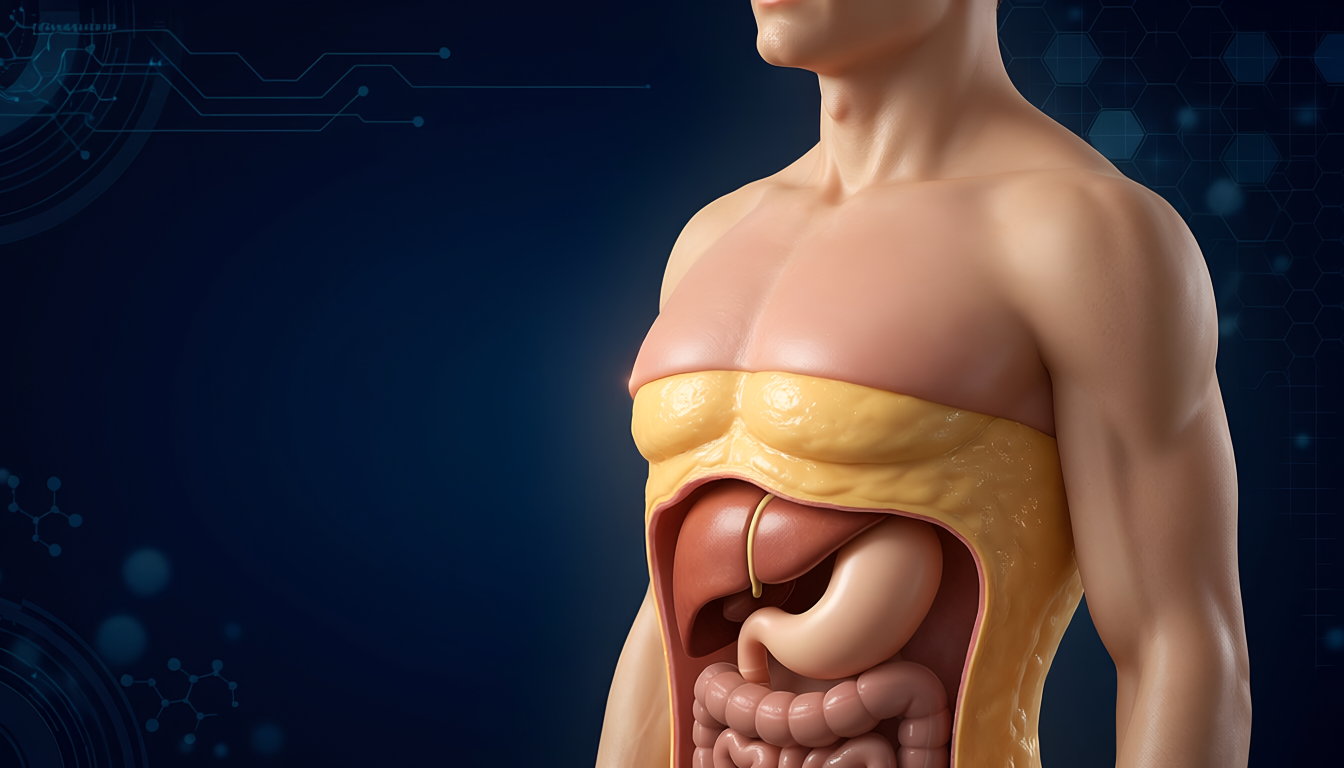
Body fat isn’t a design flaw — it’s a highly organized, hormone-producing organ that your body relies on to store energy, protect organs, and survive periods without food. Fat gain happens when you take in more energy than your body uses over time, and your body responds by enlarging existing fat cells and, when needed, creating new ones to hold the surplus safely. Understanding fat as a functional, living tissue — not just “extra weight” — is the foundation for every other post in this series (Endotext, adipose tissue physiology).
Why is my body storing more energy?
That’s the more useful question, and it’s where the science actually starts.
Key Takeaways
- Body fat (adipose tissue) is a living, hormone-secreting organ, not inert padding.
- Storing extra energy as fat is a survival adaptation refined over human evolutionary history, protecting against unpredictable food availability.
- Fat cells store energy in two ways: growing larger (hypertrophy) or increasing in number (hyperplasia).
- Where the body stores fat is at least as important to health as how much it stores.
- Understanding fat storage as a system — not a personal failure — is the first step toward improving metabolic health.
Your Body Was Built for Uncertainty, Not Abundance
For nearly all of human history, food supply was unpredictable. There were no grocery stores, refrigerators, or year-round harvests — just cycles of abundance and scarcity. The people who survived those cycles weren’t necessarily the strongest; they were the ones whose bodies were most efficient at storing extra energy during good times so they could draw on it during lean ones.
That same biological system is still running in your body today. Your metabolism doesn’t know that food is now available around the clock — it still behaves as though scarcity could return at any time. So when you eat more energy (measured in calories) than your body needs in the moment, it stores the surplus rather than wasting it. That’s not a malfunction. It’s the system working as intended.
Body Fat Is Your Emergency Energy Reserve
Think of body fat as a savings account for energy. Every meal makes a “deposit.” Your body immediately “withdraws” what it needs to keep your heart beating, your brain active, and your muscles moving. Whatever is left over gets stored for later use.
For most of human history, this reserve was the difference between surviving a famine and not. Fat storage wasn’t a flaw in the system — it was one of the traits that allowed humans to survive unpredictable environments (Boudreau et al., 2020, Open Biology).
Body Fat Is Alive — and Constantly Communicating
It’s easy to picture body fat as inert tissue sitting quietly under the skin. That picture is outdated. Adipose tissue (the scientific name for body fat tissue) is now recognized as an active endocrine organ — meaning it produces and releases hormones that travel through the bloodstream and influence other organs (Xu et al., 2016, Experimental & Molecular Medicine).
Fat tissue helps regulate appetite, influences how your body uses insulin, supports immune function, cushions organs, stores certain vitamins, and helps maintain body temperature. One of its best-studied hormones is leptin, which signals to your brain how much energy is currently stored; as fat stores increase, leptin levels generally rise, and the brain uses that signal as part of its system for regulating hunger and energy use (Leptin as a key regulator of the adipose organ, 2022). Without functioning fat tissue, the body cannot regulate these processes properly — which is part of why both too much and too little body fat can cause health problems, a topic we cover in detail in Part 3.
The goal was never to eliminate body fat. The goal is to keep this system working the way it’s supposed to.
Meet Your Fat Cells
Fat cells, called adipocytes, act like individual storage lockers. When extra energy arrives, these cells package it as triglycerides (a storage form of fat) and hold it until the body needs it later.
At first, existing fat cells simply grow larger — a process called hypertrophy. If those cells approach their storage limit, the body can generate additional fat cells, called hyperplasia (Kahn, Wang & Lee, 2019, Journal of Clinical Investigation). This isn’t the body making a mistake — it’s solving a logistics problem: how to safely hold surplus energy without letting it damage other tissues.
A Carefully Organized Storage System
One common myth is that fat simply accumulates wherever there happens to be room. It doesn’t. The body follows a fairly consistent storage hierarchy: some locations are built to safely hold energy for years, while others are only used once the primary storage areas are approaching capacity.
This is a major reason two people can weigh the same amount and have similar total body-fat percentages, yet carry very different long-term health risks (clinical review of visceral adiposity, PMC). Where fat is stored can matter as much as how much of it there is — a discovery that has reshaped how researchers think about obesity and metabolic disease.
Why This Reframe Matters
Once you understand body fat as a carefully regulated survival system rather than a personal failing, the question changes. Instead of asking, “Why is my body working against me?” a more productive question is, “Why does my body believe it needs to store more energy right now?”
That shift matters because lasting improvements in body composition and metabolic health come from working with your biology, not fighting it. In Part 2 of this series, we break down exactly where your body puts that stored energy — including the two forms of fat that matter most for long-term health.
Frequently Asked Questions
Is body fat bad for you?
No — a functional amount of body fat is essential. Fat tissue stores energy, produces hormones, cushions organs, and supports immune and reproductive function. Problems tend to arise from the location and health of fat tissue, and from either excess accumulation in high-risk areas or extremely low levels, not from fat’s mere presence (Endotext, adipose tissue physiology).
Why does the body store fat instead of just using all the energy it takes in?
Storing surplus energy protected humans against unpredictable food supply for most of history. That survival mechanism hasn’t disappeared just because food is now consistently available (Boudreau et al., 2020).
What’s the difference between fat cells getting bigger and the body making new ones?
Existing fat cells enlarging is called hypertrophy. The body creating new fat cells is called hyperplasia. Both are normal responses to a sustained energy surplus (Kahn, Wang & Lee, 2019).
Is body fat really an organ?
Yes. Adipose tissue is classified as an endocrine organ because it secretes hormones — including leptin and adiponectin — that communicate with the brain, liver, muscles, and immune system (Xu et al., 2016).
Does where fat is stored matter more than how much fat you have?
Both matter, but location is a critical piece many people overlook. Two people with similar body weight or body-fat percentage can have very different metabolic risks depending on where that fat is stored — a topic explored fully in Part 2 (clinical review of visceral adiposity).
Coming Next
If your body follows an organized storage plan, where does it actually decide to put the fat? In Part 2, we explore the different types of body fat — including subcutaneous and visceral fat — and why their location can have a powerful impact on long-term health.
Want to go deeper? The 21-Day Metabolic Friction Reset is a day-by-day, 21-day plan for removing the everyday friction behind stalled progress. See the program →