Every diet works for somebody. None of them work for everybody. The difference between a diet that changes your life and one that wastes six months isn’t willpower — it’s whether the diet’s mechanism matches the signal your body is actually sending.
This guide breaks down thirteen major dietary approaches the same way we break down every compound and protocol: what it is, what’s actually proven, what’s still being studied, and who it fits best. No hype, no “this diet cures everything.” Just the signal-to-noise ratio, so you can pick with your eyes open.
This edition adds one more layer: the brain. Your brain runs on what you eat — literally, in the form of glucose, fatty acids, and amino acids, and chemically, in the form of the neurotransmitters and hormones those nutrients get converted into. Every diet in this guide isn’t just changing your waistline or your bloodwork. It’s changing the raw material your brain uses to make dopamine, serotonin, and stress hormones — which then changes your mood, your cravings, and your next food choice. That’s the loop.
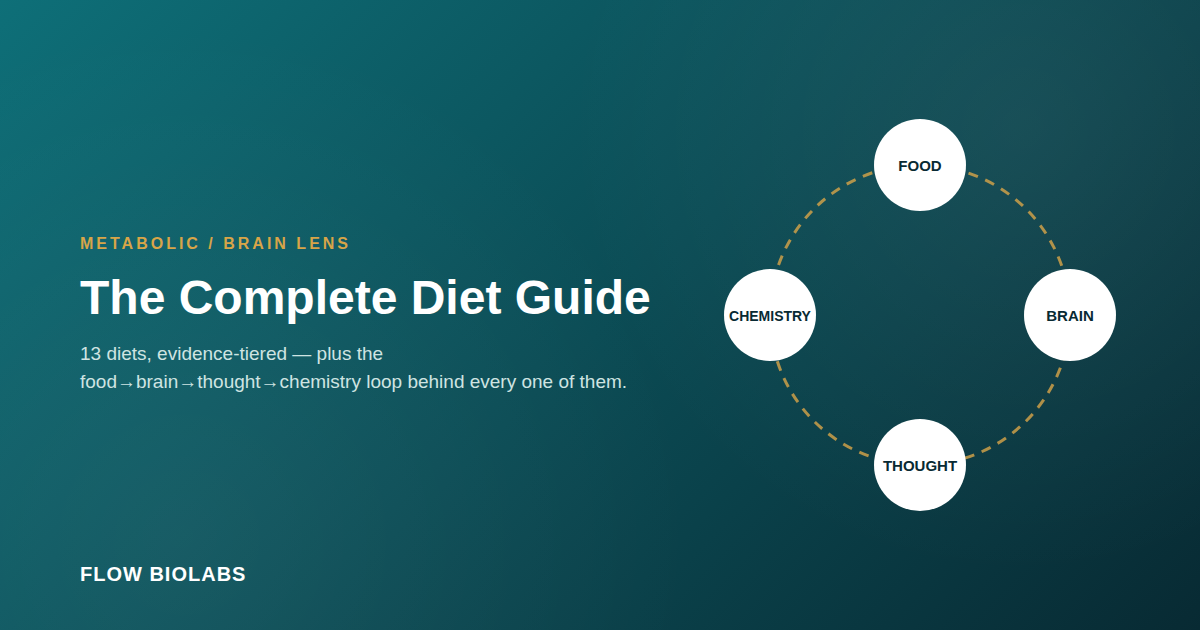
The Food → Brain → Thought → Chemistry Loop
Here’s the short version of a pattern that shows up in every diet below:
- What you eat determines what raw materials reach your brain (glucose for fuel, tryptophan for serotonin, tyrosine for dopamine, omega-3s for membrane function, B vitamins as cofactors).
- The brain converts those materials into chemistry — neurotransmitters and hormones that don’t just affect mood in the abstract, they directly drive hunger, cravings, motivation, and impulse control.
- That chemistry produces a thought or urge — “I need sugar right now,” “I feel calm,” “I can’t focus,” “I want to eat everything in sight.”
- The thought drives the next food choice — which restarts the loop, for better or worse.
A diet that’s technically “healthy” but starves this loop of what the brain needs will fight you at the willpower level no matter how good the macros look on paper. A diet that respects the loop makes discipline easier because the brain isn’t working against you.
Each diet below now includes a Brain & Signal Loop section applying this specifically.
Quick Comparison Chart
| Diet | Carbs | Protein | Fat | Difficulty | Best For |
|---|---|---|---|---|---|
| Ketogenic | Very Low | Moderate | Very High | Hard | Seizure control, fat loss, blood sugar |
| Carnivore | None | Very High | High | Very Hard | Elimination/autoimmune testing, simplicity |
| Mediterranean | Moderate | Moderate | Moderate-High (unsaturated) | Easy | Heart health, longevity, sustainability |
| Vegan | High | Low-Moderate | Low-Moderate | Moderate | Ethics/environment, LDL reduction |
| Paleo | Moderate | High | Moderate-High | Moderate | Cutting processed food, whole-food reset |
| Intermittent Fasting | Varies | Varies | Varies | Moderate | Insulin sensitivity, simplicity, adherence |
| Time-Restricted Eating | Varies | Varies | Varies | Easy-Moderate | Circadian alignment, sleep, metabolic markers |
| Low FODMAP | Low (specific carbs) | Varies | Varies | Hard | IBS symptom identification |
| Whole30 | Moderate | Moderate-High | Moderate | Hard (short-term) | Food sensitivity discovery, habit reset |
| DASH | Moderate-High | Moderate | Low-Moderate | Easy | Blood pressure |
| Flexitarian / IIFYM | Flexible | Flexible | Flexible | Easy | Long-term adherence, body composition goals |
| Carb Cycling | Variable by day | High | Variable by day | Hard | Physique athletes, performance + leanness |
| Autoimmune Protocol (AIP) | Low-Moderate | High | Moderate | Very Hard | Autoimmune flare identification |
Match Your Goal to a Diet
- Fat loss, simplest path: Intermittent Fasting or Flexitarian/IIFYM
- Fat loss, fastest short-term: Ketogenic or Carnivore
- Longevity / heart health: Mediterranean or DASH
- Gut or autoimmune symptoms: Low FODMAP, AIP, or Whole30
- Performance + physique: Carb Cycling
- Blood sugar control: Ketogenic, Mediterranean, or Time-Restricted Eating
- Sustainability for life: Mediterranean or Flexitarian/IIFYM
- Ethical/environmental motivation: Vegan
- Mood + focus, most direct path: Mediterranean or Time-Restricted Eating (best-supported brain evidence of the group)
1. Ketogenic (Keto)
What it is: A very-low-carb, high-fat diet (typically under 50g net carbs/day) that shifts the body into ketosis, burning fat and ketone bodies for fuel instead of glucose.
Known: Highly effective and recognized as a treatment for drug-resistant epilepsy, especially in children. Reliably lowers blood glucose and HbA1c in type 2 diabetics short-term.
Promising: Meaningful short-to-medium-term fat loss and appetite suppression, likely through improved satiety and reduced insulin spikes.
Emerging: Long-term cardiovascular effects are mixed — LDL cholesterol rises in a meaningful subset of people. Long-term adherence is poor for most people.
Caution: Not appropriate for anyone with a history of gallbladder issues, pancreatitis, or certain rare metabolic disorders without medical supervision.
Brain & Signal Loop: Ketones can cross the blood-brain barrier and serve as an alternative fuel source when glucose is scarce — part of why some people report unusually stable, “clean” focus once fat-adapted. The flip side: the first 1-2 weeks of restriction often includes brain fog and irritability as the brain adjusts fuel sources. Very-low-carb intake also reduces dietary tryptophan and can blunt serotonin production in some people.
2. Carnivore
What it is: An all-animal-product diet — meat, fish, eggs, and often dairy — eliminating all plant foods.
Known: Functions as an extreme elimination diet, genuinely useful for identifying plant-based food sensitivities.
Promising: Anecdotal reports of reduced joint pain and GI symptoms in autoimmune populations, though not yet backed by controlled trials.
Emerging: No long-term studies exist on cardiovascular or colorectal cancer risk with sustained zero-fiber, all-animal eating.
Caution: Not something to run indefinitely without bloodwork monitoring.
Brain & Signal Loop: Animal products are dense in the direct precursors for dopamine and serotonin (tyrosine and tryptophan) and in B12. But removing fiber removes the fuel source for gut bacteria that produce short-chain fatty acids linked to mood regulation. Researchers are still mapping the net effect on the loop.
3. Mediterranean
What it is: Emphasizes vegetables, fruit, whole grains, legumes, olive oil, fish, and moderate wine, with limited red meat and processed food.
Known: One of the most heavily studied diets in existence. Strong evidence for reduced cardiovascular events and all-cause mortality.
Promising: Associated with lower rates of cognitive decline and depression in observational data.
Emerging: Much of the strongest data is Mediterranean-population-specific.
Caution: Minimal — one of the safest diets across nearly all populations.
Brain & Signal Loop: This is the best-evidenced diet in the entire guide for direct brain benefit. Omega-3s from fish support neuron membrane structure and are linked to lower depression risk; olive oil’s polyphenols are associated with slower cognitive decline; and the steady, moderate-glycemic carb load avoids the blood sugar spikes and crashes that drive irritability and brain fog.
4. Vegan
What it is: Excludes all animal products — meat, dairy, eggs, honey.
Known: Reliably lowers LDL cholesterol and blood pressure when done with whole foods.
Promising: Associated with lower rates of certain cancers and type 2 diabetes in large observational cohorts.
Emerging: Long-term adequacy without supplementation is a real concern — B12, vitamin D, iron, zinc, omega-3s all require deliberate planning.
Caution: Requires B12 supplementation, full stop — there is no reliable plant source.
Brain & Signal Loop: This is the diet where the loop most depends on supplementation discipline. B12 is required to make several neurotransmitters and maintain the myelin sheath — unsupplemented deficiency shows up as brain fog and mood changes. Plant-based omega-3s convert to brain-active forms very inefficiently, so a well-run vegan diet for brain health usually means algae-based DHA supplementation.
5. Paleo
What it is: Eats like pre-agricultural humans theoretically did — meat, fish, vegetables, fruit, nuts, seeds — excluding grains, legumes, dairy, and processed sugar.
Known: Effective at eliminating ultra-processed food and added sugar.
Promising: Some improvement in inflammatory markers and insulin sensitivity in short trials.
Emerging: The evolutionary premise itself is contested by anthropologists.
Caution: Can be expensive and socially restrictive long-term.
Brain & Signal Loop: Removing ultra-processed food and added sugar removes the sharpest blood-sugar spikes and crashes — one of the most common everyday drivers of the “urge → eat → crash → urge again” version of the loop. Nuts, seeds, and fish also supply omega-3s and magnesium tied to mood regulation.
6. Intermittent Fasting (16:8, 5:2, Alternate-Day)
What it is: Restricts eating to specific time windows or days rather than restricting what you eat.
Known: Produces fat loss comparable to continuous calorie restriction when total calories are matched.
Promising: Some independent benefit to insulin sensitivity and markers of cellular repair (autophagy).
Emerging: Whether IF provides benefits beyond simple calorie restriction is still debated. Effects on women’s hormonal cycles are understudied.
Caution: Not appropriate for anyone with a history of disordered eating.
Brain & Signal Loop: Fasting windows raise ghrelin, and ghrelin doesn’t just signal “eat” — animal research links it to increased dopamine signaling and can sharpen focus in a fasted state. That’s a real, double-edged part of the loop: the same chemistry that can sharpen focus can tip into irritability (“hangry”) if the fast runs too long.
7. Time-Restricted Eating (TRE)
What it is: A specific form of intermittent fasting focused on aligning the eating window with circadian rhythm.
Known: Eating in alignment with circadian rhythm improves markers of glucose control independent of weight loss.
Promising: Early evidence suggests earlier eating windows outperform identically-timed later windows for metabolic markers.
Emerging: Optimal window length and timing are not yet standardized.
Caution: Same fasting-related cautions as general IF apply.
Brain & Signal Loop: This diet ties most directly into sleep, which is itself a brain-chemistry issue. Late-night eating raises blood glucose and insulin at a time the body is winding down, interfering with the evening rise in melatonin. Poor sleep is one of the strongest known drivers of next-day cravings and impaired impulse control.
8. Low FODMAP
What it is: Temporarily eliminates fermentable carbohydrates that commonly trigger digestive symptoms, then systematically reintroduces them.
Known: Strong clinical evidence for reducing IBS symptoms.
Promising: May help with other functional GI disorders beyond diagnosed IBS.
Emerging: Not intended as a permanent diet — long-term restriction can reduce beneficial gut bacteria diversity.
Caution: Best done with a dietitian’s guidance for the reintroduction phase.
Brain & Signal Loop: IBS and anxiety/mood symptoms are tightly linked through the gut-brain axis — the vagus nerve carries signal traffic in both directions, and gut inflammation can itself worsen mood. Calming the gut via Low FODMAP can quiet that irritation signal and indirectly improve mood and mental clarity.
9. Whole30
What it is: A strict 30-day elimination of sugar, alcohol, grains, legumes, dairy, and processed food, followed by structured reintroduction.
Known: Effective short-term for breaking processed-food and sugar habits.
Promising: Self-reported improvements in energy, sleep, and skin are common.
Emerging: No peer-reviewed long-term outcome data exists on the Whole30 program specifically.
Caution: Not designed to be sustained past 30 days.
Brain & Signal Loop: Removing added sugar and alcohol for 30 days is, functionally, a reset of the reward-chemistry side of the loop. Frequent dopamine spikes from sugar and alcohol can blunt baseline dopamine sensitivity over time — part of why cravings feel quieter by the end of the month. The reintroduction phase is a legitimate self-experiment in mapping your own version of the loop.
10. DASH (Dietary Approaches to Stop Hypertension)
What it is: Emphasizes fruits, vegetables, whole grains, and lean protein while limiting sodium, red meat, and added sugar.
Known: One of the most rigorously trial-tested diets for lowering blood pressure.
Promising: Associated benefits for weight management and reduced risk of type 2 diabetes.
Emerging: Less studied for outcomes outside cardiovascular/blood pressure.
Caution: Minimal; one of the safest and most broadly recommended diets.
Brain & Signal Loop: Chronic hypertension damages small blood vessels in the brain over time and is an established risk factor for cognitive decline. DASH’s direct effect on blood pressure is therefore also an indirect, long-horizon brain-protective effect.
11. Flexitarian / IIFYM (“If It Fits Your Macros”)
What it is: Sets daily targets for protein, carbs, and fat but places no restriction on food source, timing, or “clean vs. processed.”
Known: Body composition change is driven primarily by total calories and protein intake, not food source.
Promising: Tends to have the best long-term adherence of any approach in this guide.
Emerging: Doesn’t inherently account for micronutrient adequacy or food quality.
Caution: Works best when paired with a baseline quality standard.
Brain & Signal Loop: This is the diet where the loop depends entirely on how it’s executed. Hitting macros with whole foods feeds the loop well; hitting the same macros with ultra-processed food means missing the micronutrients the brain needs as cofactors for neurotransmitter production.
12. Carb Cycling / Cyclical Keto
What it is: Alternates between low-carb and higher-carb days, often used by physique and strength athletes.
Known: Refeed days can restore glycogen and support training intensity.
Promising: May help preserve lean mass during a fat-loss phase better than continuous low-carb eating.
Emerging: Optimal cycling schedules are highly individual and under-researched.
Caution: More complex to execute correctly than most diets on this list.
Brain & Signal Loop: Carbohydrate intake raises insulin, which helps tryptophan cross into the brain more readily to be converted into serotonin — a plausible mechanism behind the mood lift many people report on higher-carb refeed days.
13. Autoimmune Protocol (AIP)
What it is: A stricter version of Paleo that also removes nightshades, eggs, nuts, seeds, and dairy.
Known: Small clinical studies show meaningful symptom improvement during the elimination phase.
Promising: Growing interest in AIP for other autoimmune conditions.
Emerging: Research base is thin compared to more mainstream diets.
Caution: The elimination phase is nutritionally restrictive and not meant to be permanent.
Brain & Signal Loop: Systemic inflammation isn’t just a joint and gut issue — inflammatory cytokines can act on the brain directly and are associated with fatigue, brain fog, and depressive symptoms (“sickness behavior”). Calming systemic inflammation through AIP’s elimination phase may improve mental clarity alongside physical symptoms.
Which Diet Fits — Now What?
Reading the list above is step one. Actually building a week of meals around your best-fit diet, with your specific goals and signals factored in, is a different problem.
If you’re ready to put a plan behind the pattern you just identified, the 21-Day Metabolic Friction Reset takes the same signal-first approach and builds it into a full day-by-day protocol.
Disclaimer: This guide is educational and not a substitute for personalized medical or nutritional advice. Anyone with an existing medical condition, on medication, pregnant, or breastfeeding should consult a physician before changing their diet.