
This is part of Flow BioLabs’ Recover & Perform path — see the full guide →.
The short answer: TB-500 is a synthetic peptide built around the active fragment of Thymosin Beta-4 (Tβ4), a naturally occurring protein involved in cell movement and wound repair. Its core job, based on lab research, is regulating actin — a structural protein that cells use like an internal skeleton to move and change shape.
What Is TB-500?
TB-500 refers to a synthetic peptide sequence based on the actin-binding region of Thymosin Beta-4 (Tβ4), a small, 43-amino-acid protein found naturally in nearly all human tissues, especially blood platelets and cells involved in wound healing (Xu et al., 2021). Unlike hormones, which typically bind to receptors on the outside of a cell to trigger a chain reaction, TB-500 works mainly inside and around cells by regulating actin — the structural protein that gives cells their shape and lets them move.
It’s important to understand the distinction between TB-500 and the full Tβ4 protein it’s derived from. Most of the promising clinical (human) data discussed in wound-healing research involves the complete Tβ4 molecule, not the shorter TB-500 fragment sold in research and compounding channels. Whether TB-500 reproduces the same effects as full-length Tβ4 has not been established in humans.
How TB-500 Appears to Work: Key Cellular Mechanisms
The proposed mechanisms below come primarily from cell-culture and animal studies of Thymosin Beta-4.
Actin Binding and the “Buffer Pool” Effect
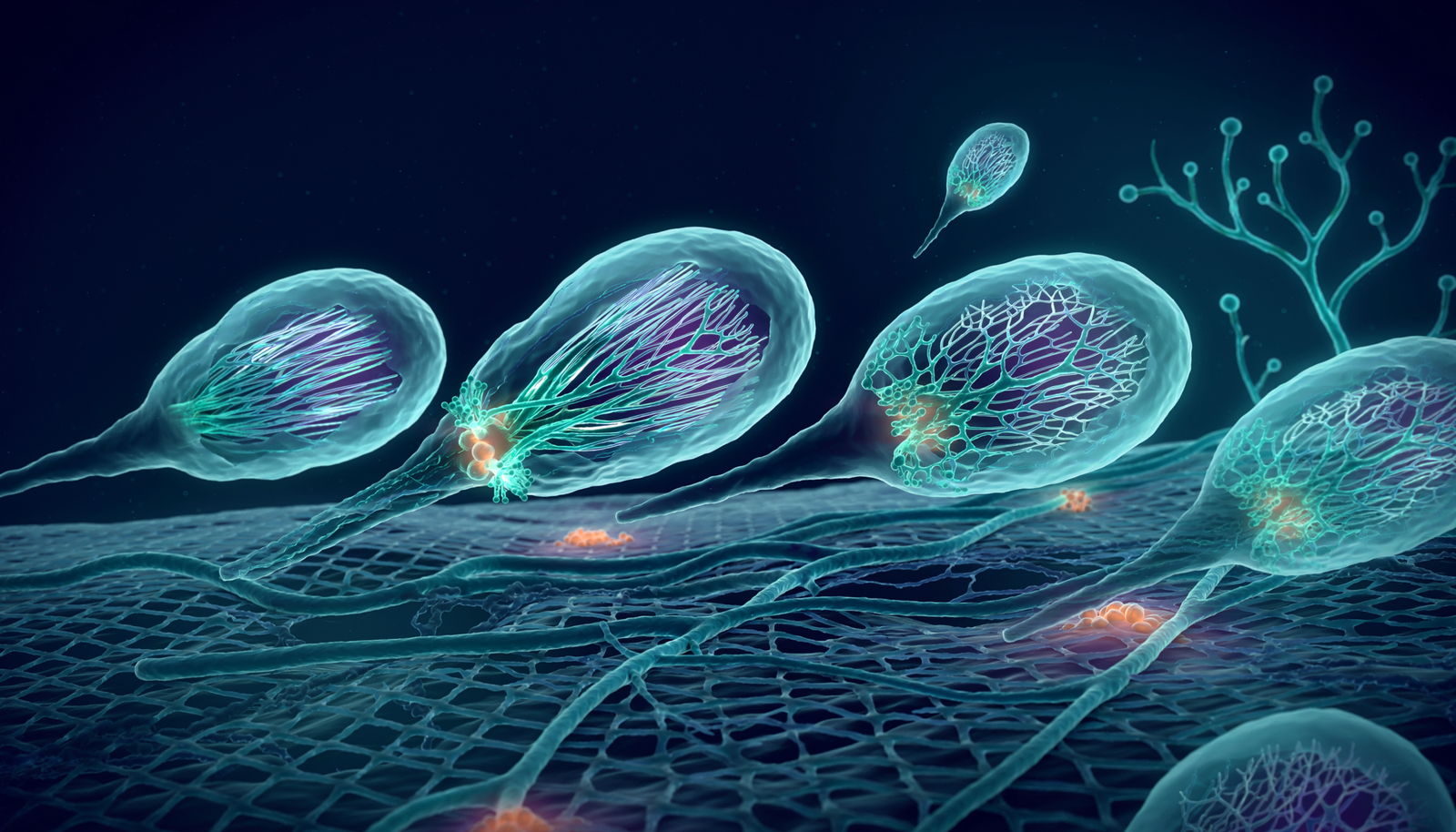
Actin exists in two forms inside cells: individual building-block units (G-actin) and assembled filament chains (F-actin) that give the cell structure and let it move. Structural studies using X-ray crystallography show that the LKKTETQ segment of Tβ4 binds G-actin in a 1:1 ratio, holding a reserve pool of these units so they’re ready for rapid assembly when a cell needs to move (structural crystallography studies reviewed in Xu et al., 2021). This buffering function is considered the central, best-established mechanism — everything else attributed to Tβ4 is thought to happen downstream of it.
Cell Migration and Motility
For a wound to heal, specialized cells — including endothelial cells (which line blood vessels), fibroblasts (which build connective tissue), and keratinocytes (skin cells) — need to physically migrate across the injury site. By regulating how quickly actin filaments assemble and disassemble, Tβ4 is thought to give these cells the mobility to navigate the extracellular matrix, the mesh-like scaffold of proteins surrounding cells (Xu et al., 2021).
Reduced Scarring and Organized Matrix Remodeling
A consolidated review of Tβ4 research links the protein to reduced numbers of myofibroblasts (cells associated with scar-tissue formation), along with more organized collagen deposition in healing tissue — potentially limiting excess fibrosis, or stiff scar tissue, in animal wound models (Xu et al., 2021).
Cell Survival and Cardiac Signaling
In mouse models, full-length Tβ4 formed a complex with proteins called PINCH and integrin-linked kinase (ILK), activating a cell-survival pathway (Akt) after induced heart attacks. This was associated with improved early heart-muscle-cell survival and better cardiac function in the animal model (preclinical cardiac studies reviewed in Xu et al., 2021). These cardiac and neurological effects have been demonstrated with full-length Tβ4 — researchers are still studying whether the shorter TB-500 fragment reproduces them.
What Human Evidence Exists — for Tβ4, Not TB-500 Specifically
Full-length Thymosin Beta-4 has been tested in a small number of completed Phase 2 human trials, and the results are genuinely mixed:
- In a trial of 143 patients with chronic pressure ulcers and venous stasis ulcers, topical Tβ4 gel was associated with faster healing — by almost a month — but only among patients whose wounds healed at all; the difference did not reach statistical significance in the full sample (Xu et al., 2021; RegeneRx Phase II Pressure Ulcer Trial Results).
- A separate double-blind, placebo-controlled dose-escalation study in 73 patients with venous stasis ulcers found a specific dose (0.03%) was associated with faster wound healing, with about 25% of patients achieving complete healing within three months, mainly those with smaller or less severe wounds (Treadwell et al., 2010).
- The larger, U.S.-based Phase 2 pressure ulcer trial (72 patients) reported that Tβ4 was safe and well tolerated at all doses tested, but found no statistically significant difference in complete wound healing compared to placebo (RegeneRx Phase II Trial Results, 2009).
Across these trials, Tβ4 was consistently reported as safe and well tolerated, including in single intravenous doses up to 1,260 mg (Xu et al., 2021). But efficacy findings were inconsistent — some trials showed a trend toward faster healing without reaching statistical significance, while none showed a clear, reliable therapeutic effect across the board. Critically, these trials used the full 43-amino-acid Tβ4 protein applied topically — not the shorter TB-500 fragment marketed today, and not systemic injection. There is no published controlled human trial of injectable TB-500 itself.
Biological Focus: Cellular Logistics in High-Stress Tissues
Tissues under intense mechanical load — muscle fibers, fascia, skin, and connective tissue — experience frequent micro-tears that require coordinated cell migration to repair. In preclinical models, adequate cytoskeletal control (the actin regulation described above) is thought to help repair cells arrive at injury sites more efficiently and organize the structural proteins needed for tissue rebuilding (Xu et al., 2021). In research and compounding contexts, TB-500 is frequently discussed alongside BPC-157, since the two are proposed to act on complementary mechanisms — blood vessel growth versus cell motility — though this combined-use rationale has not been tested in controlled human trials.
Regulatory Status and Safety Considerations
That committee vote is a non-binding recommendation; formal rulemaking, which can take a year or more, would still be required before TB-500 could legally be compounded. Because TB-500 lacks its own published human trial data, there is no established human safety or dosing profile specific to the fragment — safety inferences drawn from full-length Tβ4 studies may not directly apply.
Frequently Asked Questions
Is TB-500 the same as Thymosin Beta-4?
No. TB-500 is a synthetic fragment built around the actin-binding portion of the full 43-amino-acid Thymosin Beta-4 protein. Most published human trial data relates to full-length Tβ4, not the shorter TB-500 fragment (Xu et al., 2021).
Has TB-500 been tested in humans?
Not directly. The completed Phase 2 human trials used topical, full-length Thymosin Beta-4 for chronic wounds like pressure ulcers and venous stasis ulcers, with mixed results. No published controlled human trial has tested injectable TB-500 specifically (Treadwell et al., 2010).
What does TB-500 actually do at the cellular level?
Based on research into Thymosin Beta-4, it’s thought to regulate actin — the structural protein cells use to move and change shape — which may support cell migration to injury sites, reduce excess scar tissue, and, in animal cardiac models, support cell survival signaling (Xu et al., 2021).
Why are BPC-157 and TB-500 often mentioned together?
They’re proposed to act on different, complementary mechanisms in preclinical research — BPC-157 for new blood vessel formation and TB-500 for cell migration via the actin cytoskeleton. This combination has not been evaluated in controlled human trials.
Educational Disclaimer
This article is for educational and scientific-communication purposes only. It does not constitute medical advice and is not a recommendation to use TB-500 or any peptide. If you’re considering any peptide therapy, talk with your own licensed healthcare provider first, and use our free Peptide Calculator to sanity-check dosing and reconstitution math before you start.
Want to go deeper? The Flow BioLabs Recovery Stack is all three systems in sequence: Deep Sleep Rebuild, Metabolic & Mitochondrial Optimization, and Lab Interpretation. See the program →