
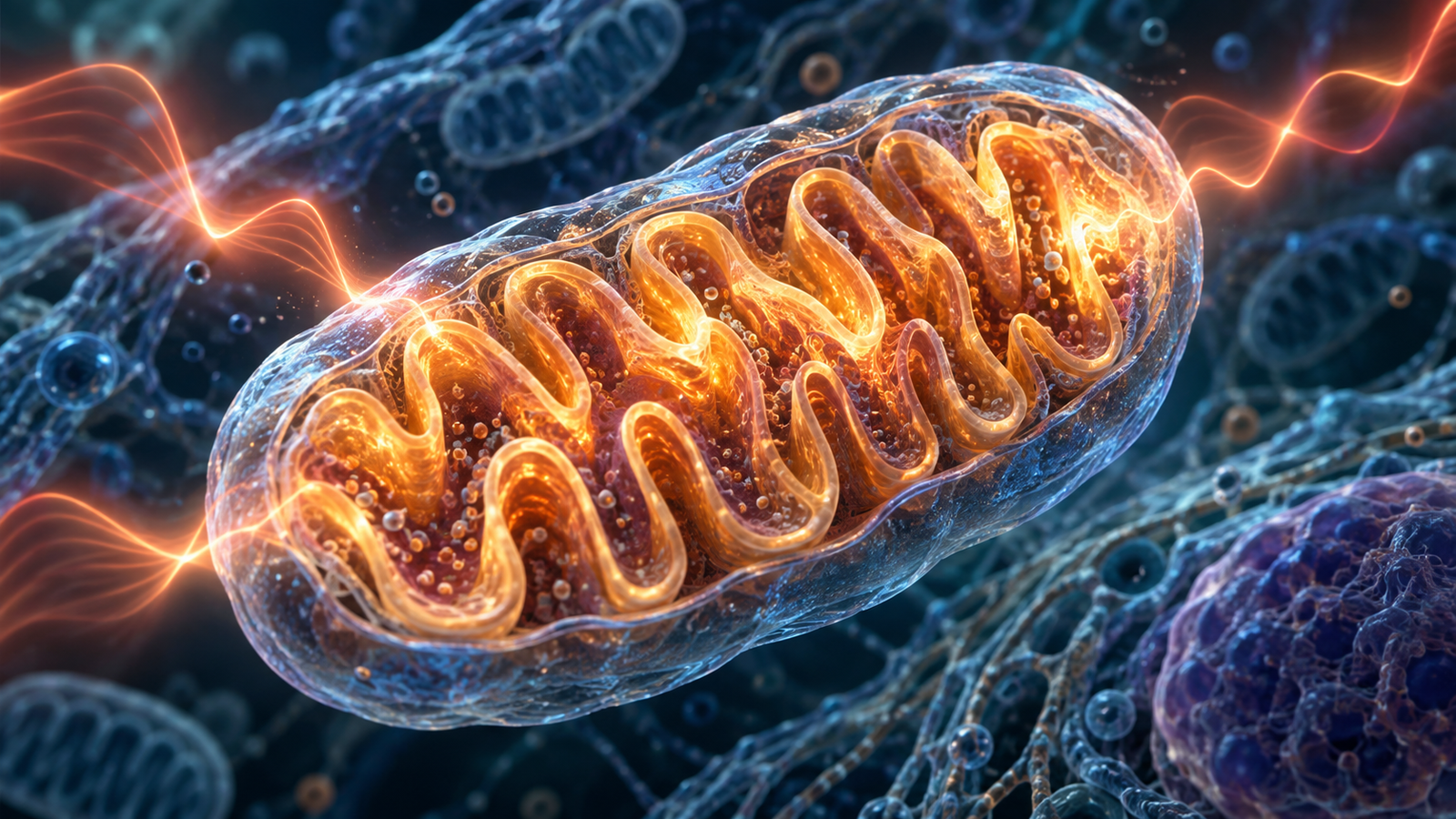
Researchers have reported an unusual 71-terahertz signal associated with intact mitochondria and proposed that a hybrid light-matter state may help explain it. In the same 2026 preprint, selected infrared frequencies were also associated with higher ATP measurements in cultured human cells.
The work is preliminary, but it raises an important scientific question: could organized mitochondrial structure support physical behavior that contributes to cellular energy regulation in ways we do not yet fully understand?
This article looks at what the researchers measured, what mechanism they proposed, how the ATP experiment was performed, and what still needs to be tested.
What the 2026 mitochondrial study reported
In September 2026, Yu Yang, Zhenglong Gu and Bo Song posted the preprint A Quantum State of Mitochondria in the Living Cell on bioRxiv. The team used infrared spectroscopy to study human HEK-293T cells, mouse tissues and isolated mitochondria.
They reported a spectral feature near 71.0 THz. According to the paper, the signal appeared in living cells and tissues and in isolated mitochondria that retained their organization. When samples were dried or mitochondrial structure was disrupted, the feature was no longer observed.
That structural dependence is one of the most interesting parts of the study. It suggests that the signal may depend on the organized physical environment of the mitochondrion rather than on a single isolated molecule.
Primary source: Yang Y, Gu Z, Song B. A Quantum State of Mitochondria in the Living Cell. bioRxiv. 2026.
Why the 71 THz signal matters
Mitochondria are central to cellular energy metabolism. Their inner membranes are folded into cristae, which organize much of the machinery involved in ATP production.
The authors focused on molecular vibrations in mitochondrial membrane lipids near 87 THz. They proposed that strong coupling between electromagnetic energy and those molecular vibrations could produce two hybrid states, including one near 71 THz.
That predicted frequency is close to the signal measured in the experiments.
The authors describe the proposed hybrid state as a mitochondrial polariton, or “mito-polariton.” Polaritons are established in physics as hybrid states created when electromagnetic fields interact strongly with matter.
Background source: Dunkelberger AD, et al. Vibration-Cavity Polariton Chemistry and Dynamics. Annual Review of Physical Chemistry. 2022;73:429-451.
What happened in the ATP experiment?
The researchers also tested whether selected infrared frequencies could influence ATP production in cultured human cells.
HEK-293T cells were exposed for 10 minutes at different frequencies. The paper reports that:
- 71 THz exposure was associated with an ATP increase of about 10.3%
- 87 THz exposure was associated with an ATP increase of about 10.1%
- 53.7 THz did not produce the same statistically significant response
The experiment is notable because the response differed by frequency. That makes the result worth following, but the experiment does not by itself establish why the ATP change occurred.
The next step is mechanism: researchers need to determine whether the response is specifically caused by the proposed polariton state or by another physical interaction within the mitochondrial membrane system.
What the polariton hypothesis proposes
The study’s central interpretation is that the organized environment of mitochondrial membranes may allow strong coupling between molecular vibrations and electromagnetic modes.
If that model is correct, the coupling could create a hybrid state with properties of both the electromagnetic field and the molecular vibration.
This is a testable hypothesis. The current observations line up with the model in several ways:
- a signal was observed near 71 THz;
- the signal depended on intact mitochondrial structure;
- the theoretical model predicts a state near the measured frequency; and
- selected infrared frequencies were associated with different ATP responses.
Those observations make the proposed mechanism scientifically interesting. More experiments are needed to determine whether the model is the best explanation.
How this fits into quantum biology
Quantum biology studies whether specific quantum phenomena contribute functionally to biological processes.
Researchers in the field investigate topics such as tunneling, coherence, spin effects and light-matter interactions. The important question is not whether biological molecules obey quantum mechanics—they do—but whether a particular quantum effect persists and matters at the scale of a living biological system.
The mitochondrial study adds a new question to that field: can the organized structure of a mitochondrion support a light-matter state that influences energy-related biology?
That question is now experimentally testable.
How this relates to light and mitochondrial research
There is already a separate body of research examining how light can affect mitochondrial biology. Photobiomodulation typically uses red or near-infrared light and has been studied in relation to mitochondrial signaling, cytochrome c oxidase, redox biology and ATP production.
The 71 THz work is different in both frequency and proposed mechanism, but the broader connection is relevant: mitochondria appear capable of responding to specific electromagnetic inputs under some experimental conditions.
Supporting sources: Hamblin MR. Mechanisms and Mitochondrial Redox Signaling in Photobiomodulation. and Trajano LASN, et al. Does photobiomodulation alter mitochondrial dynamics?
What this could eventually mean for metabolism and aging research
Mitochondria play a central role in metabolism, exercise adaptation, stress responses and aging biology. If future studies confirm that specific physical interactions can reproducibly influence ATP production, that could open new research directions.
At this stage, however, the work is still at the laboratory level. The ATP experiment used cultured cells. The study did not test whether the same effect changes human energy, metabolism, performance, aging or disease outcomes.
For more on how metabolism connects with broader health signals, read What “Metabolic Health” Actually Means. For healthy-aging context, see Three New Studies Are Quietly Rewriting What Healthy Aging Requires.
The brain connection
Cellular energy is part of the larger signal environment the brain continuously interprets. Sleep, stress, metabolism, recovery and energy availability all interact with how the nervous system regulates behavior and performance.
That is one reason mitochondrial research matters beyond the mitochondria themselves: changes in cellular energy availability can influence the information the brain has to work with.
For a deeper look at that connected-systems perspective, read Your Brain Isn’t Broken—It’s Interpreting.
What researchers need to test next
- Independent replication: other laboratories need to detect the same 71 THz feature.
- Mechanism testing: experiments need to distinguish the polariton model from other possible physical explanations.
- Additional cell types: the ATP response should be tested beyond HEK-293T cells.
- Dose-response work: frequency, intensity and exposure duration need to be mapped systematically.
- Animal studies: the phenomenon needs to be tested in intact biological systems.
- Human studies: practical health implications would require much later clinical research.
What the evidence currently supports
Observed: the preprint reports an unusual ~71 THz feature associated with intact mitochondrial structure and frequency-specific ATP changes in cultured cells.
Proposed: the authors’ model suggests that strong light-matter coupling may produce a mitochondrial polariton near the observed frequency.
Still open: whether the proposed polariton is the correct explanation, whether independent teams will reproduce the signal and ATP response, and whether the phenomenon will prove relevant in animals or humans.
Frequently asked questions
What is the 71 THz mitochondrial signal?
It is an infrared spectroscopic feature reported in living cells, mouse tissues and structurally intact isolated mitochondria. The feature was not observed after mitochondrial structure was disrupted.
Did the researchers observe higher ATP?
Yes. In cultured HEK-293T cells, the paper reports roughly 10% higher ATP measurements after exposure near 71 THz and 87 THz compared with the non-irradiated condition.
What is a mitochondrial polariton?
It is the authors’ proposed hybrid light-matter state produced by strong coupling between electromagnetic energy and molecular vibrations in mitochondrial membranes.
Has the polariton mechanism been confirmed?
No. It is the study’s proposed explanation for the observations and requires further experimental testing and independent replication.
Has the study been peer reviewed?
As of September 2026, the paper is a bioRxiv preprint and has not yet completed peer review.
Does this show that infrared exposure improves human energy?
No human effect was tested in this study. The ATP experiment was performed in cultured cells.
Want to understand your own energy and metabolic signals?
Research at the cellular level can help us understand how energy systems work. For everyday decisions, it is also useful to look at the larger pattern: sleep, stress, recovery, appetite, movement and metabolism.
Take the free Metabolic Friction Assessment to identify which signal pattern may deserve your attention first.
Educational note: This article discusses preliminary scientific research. The primary 2026 mitochondrial paper is a preprint and has not yet completed peer review.
Want to go deeper? The Flow BioLabs Recovery Stack is all three systems in sequence: Deep Sleep Rebuild, Metabolic & Mitochondrial Optimization, and Lab Interpretation. See the program →