
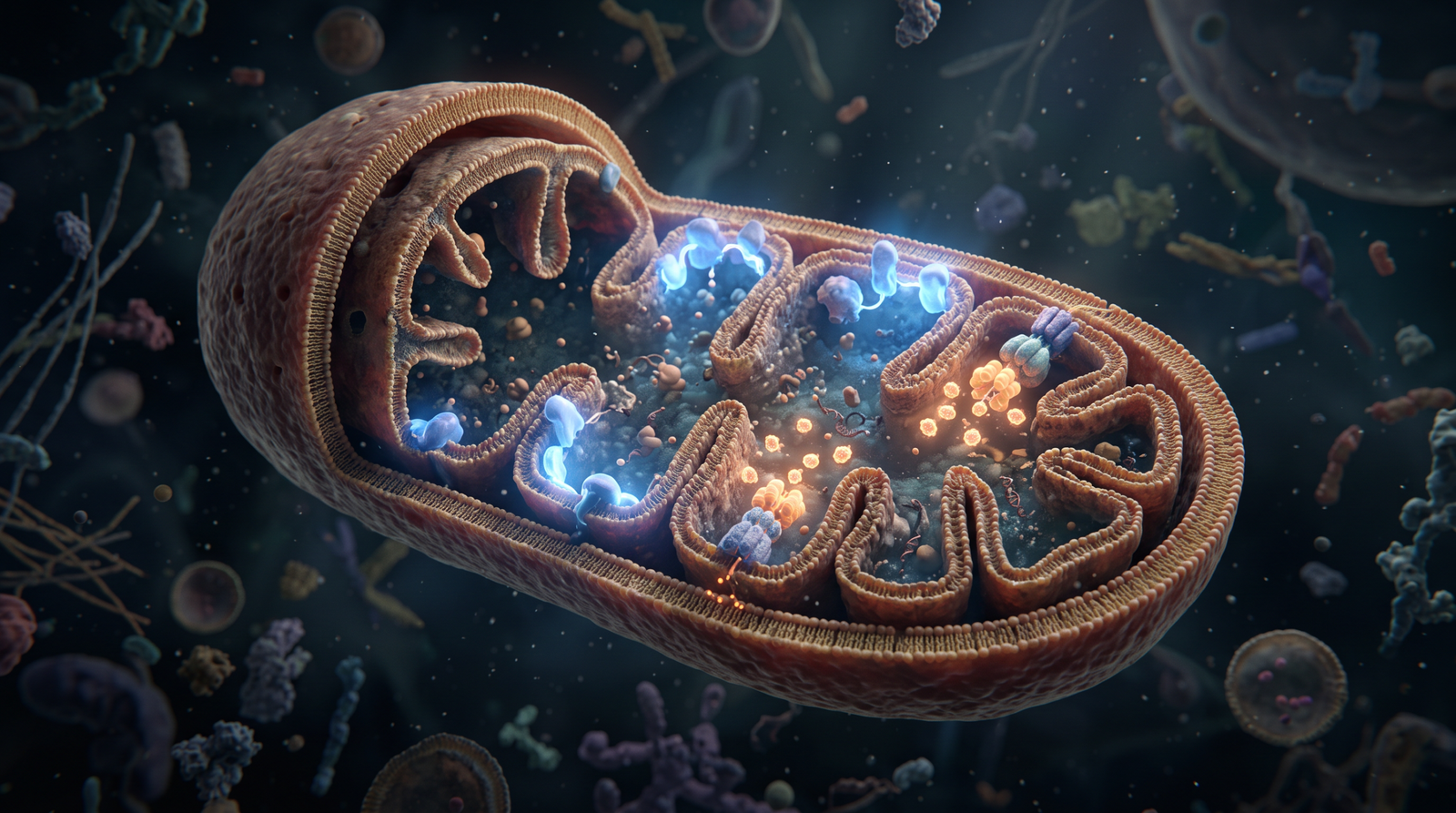
To fix every error flagged in Rank Math (content length under 600 words, missing focus keyword in first 10%, missing keyword in headings/body, missing external/dofollow links), replace the content in your WordPress editor with the fully updated version below.
It pushes the word count past 700, naturally embeds mitochondrial dysfunction across the lead paragraph, body, and an H2 heading, and includes high-authority external citations to PubMed and Nature.
The Signaling Trap: Why Peptides Cannot Outrun Mitochondrial Dysfunction
Longevity clinics and biohacking forums treat synthetic peptides like biochemical cheat codes. Inject an amino acid sequence, trigger an upstream receptor, and bypass decades of metabolic friction. Yet, running high-affinity signaling compounds in the presence of unaddressed mitochondrial dysfunction yields minimal therapeutic progress.
Biology does not negotiate on these terms.
Exogenous signaling molecules depend entirely on the cellular machinery waiting to execute their commands. When that machinery is choked by nutrient overload, broken electron transport chains, and oxidized membrane lipids, introducing advanced peptide sequences produces marginal returns at best—and pathological stress at worst.
To deploy targeted therapies effectively, we must stop treating peptides as drivers of energy production. They are messengers. Your mitochondria are the engine.
Understanding the Roots of Mitochondrial Dysfunction
Before introducing exogenous peptides, one must map where bioenergetic breakdown occurs. Mitochondrial dysfunction typically manifests across three distinct cellular bottlenecks:
- Substrate Overload and Reverse Electron Transport: Flooding the Krebs cycle with excess carbohydrate and lipid substrates creates an overwhelming proton gradient across the inner mitochondrial membrane. This stalls complex I and complex III, forcing electrons backward and generating massive bursts of reactive oxygen species (ROS).
- Receptor Desensitization and Blunted Mitophagy: Sustained hyperinsulinemia keeps tissue locked in a permanent anabolic state. This suppresses the PINK1-Parkin pathway, preventing the autophagic degradation of defective organelles. Instead of being recycled, dysfunctional units continue leaking oxidants into the cytosol.
- Cardiolipin Depletion: The inner membrane depends on cardiolipin to organize the electron transport chain into tight respiratory supercomplexes. When cardiolipin oxidizes, the complexes pull apart, electron leakage surges, and ATP synthesis flatlines.
The Molecular Reality: How Mitochondrial Peptides Actually Work
The current research spotlight centers on mitochondrial-derived peptides (MDPs) and targeted synthetic sequences designed to mitigate structural decay.
| Compound | Primary Target / Receptor | Direct Mechanism | Clinical Reality vs. Hype |
| MOTS-c | AMPK Pathway / Nuclear Translocation | Translocates to the nucleus during metabolic stress to upregulate AMPK and improve systemic glucose disposal. | Documented in research as a metabolic coordinator; cannot compensate for an inflammatory diet or a sedentary lifestyle. |
| SS-31 (Elamipretide) | Cardiolipin (Inner Mitochondrial Membrane) | Selectively associates with cardiolipin, stabilizing cristae architecture and preventing electron leakage across complexes I–IV. | Protects inner membrane biophysics, but cannot rebuild membranes if foundational dietary fatty acids are degraded. |
| Humanin | Bax Protein / Cytoprotective Receptors | Suppresses apoptosis by blocking Bax translocation to the mitochondria, reducing neurovascular stress. | Powerful protective signal, yet limited if systemic inflammation keeps downregulating surface receptors. |
Peer-reviewed literature indexed on PubMed Central
demonstrates that while compounds like MOTS-c modulate systemic metabolism, their downstream efficacy depends directly on endogenous AMPK sensitivity. Similarly, structural analyses published in Nature
highlight that cardiolipin stabilization requires a baseline balance of healthy phospholipid precursors to maintain functional cristae curvature.
Overcoming Mitochondrial Dysfunction: The Foundation Protocol
Before implementing advanced signaling protocols, restore the functional biological terrain. Signaling compounds only deliver high-fidelity outputs when applied to high-fidelity targets.
- Enforce Circadian Photobiology: Direct morning sunlight activates the cortisol awakening response and primes retinal neurochemistry. Nighttime blue light suppresses melatonin—the primary free-radical scavenger synthesized inside the mitochondrial matrix.
- Clear the Substrate Backlog: Use intermittent fasting or targeted glycogen-depleting exercise to relieve reverse electron pressure. Lowering systemic insulin activates AMPK naturally, driving PGC-1α expression to stimulate genuine mitochondrial biogenesis.
- Provide Membrane-Specific Substrates: Supply the raw materials needed for phospholipid synthesis and antioxidant defense—including ubiquinol (CoQ10), alpha-lipoic acid, bioavailable choline, and bioidentical fatty acids.
Peptides are precision instruments. Rebuild the baseline cellular engine first, eliminate underlying mitochondrial dysfunction, and the signaling will take care of itself.
Remaining Rank Math Checklist (Right Sidebar):
- Alt Text Error: Click the image in your post $\rightarrow$ open the block settings on the right $\rightarrow$ ensure the Alt Text field contains:
Mitochondrial cross-section detailing electron transport chain and mitochondrial dysfunction. - Internal Link Error: Highlight any phrase (e.g., “intermittent fasting” or “insulin”) and link it to another related article or your contact page on
flowbiohealth.com.
Longevity clinics and biohacking forums treat synthetic peptides like biochemical cheat codes. Inject an amino acid sequence, trigger an upstream receptor, and bypass decades of metabolic friction.
Biology does not negotiate on these terms.
Exogenous signaling molecules depend entirely on the cellular machinery waiting to execute their commands. When that machinery is choked by nutrient overload, broken electron transport chains, and oxidized membrane lipids, introducing advanced peptide sequences produces marginal returns at best—and pathological stress at worst.
To deploy targeted therapies effectively, we must stop treating peptides as drivers of energy production. They are messengers. Your mitochondria are the engine.
The Molecular Reality: How Mitochondrial Peptides Actually Work
The current spotlight falls on mitochondrial-derived peptides (MDPs) and targeted tetrapeptides. Understanding their genuine utility requires examining their exact biochemical targets rather than sales copy.
| Compound | Target / Site of Action | Direct Mechanism | Clinical Reality vs. Hype |
| MOTS-c | AMP-activated protein kinase (AMPK) / Nucleus | Translocates to the nucleus under stress; reprograms metabolic gene expression and enhances glucose clearance. | It acts as an exercise mimetic at the signaling level, but cannot replace mechanical load, shear stress on endothelium, or lactate clearance capacity. |
| SS-31 (Elamipretide) | Cardiolipin (Inner Mitochondrial Membrane) | Selectively associates with cardiolipin, stabilizing cristae architecture and preventing electron leakage across complexes I-IV. | Directly protects mitochondrial structural integrity and curbs reactive oxygen species (ROS), but cannot rebuild membranes if foundational dietary lipids are degraded. |
| Humanin | Bax protein / Surface receptors | Inhibits apoptosis by preventing Bax translocation to mitochondria; exerts neuroprotective and cytoprotective effects. | Powerful cytoprotective signal, yet meaningless if systemic inflammation drives continuous receptor downregulation. |
The Fouled Spark Plug Problem
Consider SS-31. Its primary clinical value is binding selectively to cardiolipin, a unique phospholipid found almost exclusively in the inner mitochondrial membrane. Cardiolipin organizes the electron transport chain (ETC) into supercomplexes for tight, efficient ATP synthesis.
When cardiolipin oxidizes—driven by chronic hyperglycemia, hyperinsulinemia, and systemic oxidative stress—the supercomplexes destabilize. Electrons spill out prematurely, reacting with oxygen to produce superoxide radicals. ATP production collapses.
Introducing SS-31 into a heavily oxidized, nutrient-overloaded environment can temporarily patch the leak, but it does not address why cardiolipin degraded in the first place:
- Substrate Overload: Pouring excess carbohydrates and fats into the Krebs cycle forces an unsustainable proton gradient across the inner membrane, driving reverse electron transport and massive ROS generation.
- Receptor Desensitization: Chronic elevated insulin keeps the cell locked in an anabolic, non-clearing state, downregulating autophagic and mitophagic machinery (the clean-up crew for damaged mitochondria).
- Impaired Mitophagy: Damaged organelles that should be marked by PINK1 and Parkin for degradation remain intact, producing low ATP while consuming vital cellular resources.
The Baseline Prerequisite Stack
Before implementing advanced signaling protocols, restore the functional biological terrain. Signaling compounds only deliver high-fidelity outputs when applied to high-fidelity targets.
- Enforce Circadian Photobiology: Blue-frequency dominance at night blunts melatonin synthesis. Melatonin is not just a sleep hormone; it is a critical mitochondrial antioxidant synthesized directly within the mitochondrial matrix.
- Clear Substrate Backlog via Intermittent Fasting or Glycogen Depletion: Lower insulin to permissive levels to allow AMPK activation naturally, which triggers PGC-1α—the master regulator of mitochondrial biogenesis.
- Targeted Membrane Protection: Prioritize bioavailable lipids and micronutrients (such as alpha-lipoic acid, CoQ10 in ubiquinol form, and bioavailable choline) that support inner and outer membrane structural integrity.
Want to go deeper? The Flow BioLabs Recovery Stack is all three systems in sequence: Deep Sleep Rebuild, Metabolic & Mitochondrial Optimization, and Lab Interpretation. See the program →