
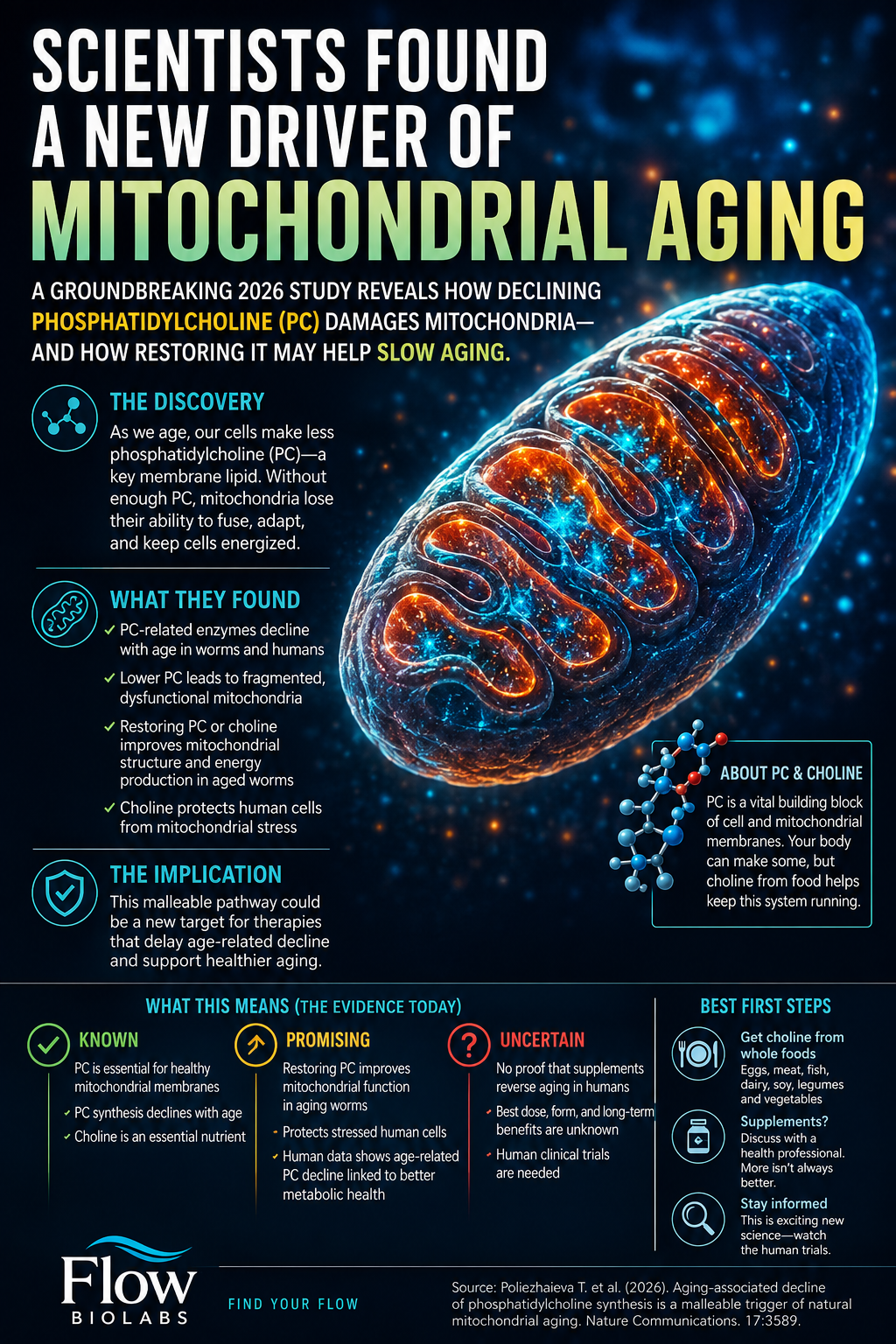
A major 2026 study points to phosphatidylcholine as a surprisingly important player in mitochondrial aging—and suggests at least part of the decline may be reversible. But the real discovery is more interesting than the “anti-aging switch” headlines.
For decades, mitochondria have been described with one of biology’s most famous clichés: the powerhouses of the cell.
That description is correct. It is also incomplete.
Mitochondria are dynamic structures that constantly change shape, merge with one another, divide, recycle damaged components, respond to nutrients and stress, and adjust energy production as conditions change.
And as we grow older, that adaptability begins to deteriorate.
The result is not simply that mitochondria “make less energy.” Aging mitochondria increasingly lose something that may be even more important:
Flexibility.
In April 2026, researchers led by Tetiana Poliezhaieva and Maria Ermolaeva at Germany’s Leibniz Institute on Aging published an intriguing study in Nature Communications identifying a previously underappreciated contributor to this deterioration.
The culprit—or at least one of them—appears to be declining production of a common membrane phospholipid called phosphatidylcholine, usually abbreviated PC.
Even more interesting, the researchers found that restoring phosphatidylcholine availability could partially restore mitochondrial structure and function in aging worms and improve mitochondrial resilience in stressed human cells.
That has produced some dramatic headlines.
“Scientists discovered an aging switch.”
“Researchers found a way to reverse aging.”
“Choline may make old mitochondria young again.”
Those statements get ahead of the science.
Nobody in this study reversed human aging. Nobody demonstrated that taking a choline supplement makes people biologically younger.
But dismissing the research because of exaggerated headlines would be an equally serious mistake.
The real finding is fascinating:
Part of mitochondrial aging may result not just from accumulating damage, but from a declining ability to manufacture the lipids mitochondria need to maintain their membranes and remodel themselves.
And unlike accumulated mutations or decades of cellular damage, lipid availability is potentially modifiable.
That distinction could matter enormously.
The study was published April 18, 2026, in Nature Communications and combined proteomics, lipidomics, genetics, mitochondrial-function testing, human gene-expression data, UK Biobank metabolomics, and experiments in cultured human cells.
First: What Exactly Are Mitochondria Doing?
Most explanations of mitochondria stop at ATP—the molecule cells use as a readily accessible form of energy.
But mitochondria are involved in far more than ATP production.
They participate in:
- cellular energy metabolism,
- fatty-acid oxidation,
- calcium regulation,
- production and management of reactive oxygen species,
- programmed cell death,
- metabolic signaling,
- stress responses,
- and communication between different parts of the cell.
Just as importantly, mitochondria are not static beans floating independently inside your cells.
They form constantly changing networks.
Individual mitochondria can fuse together, split apart, move within cells and selectively eliminate damaged sections.
This balance between fusion and fission is essential.
Fusion allows mitochondrial contents to mix. It can help compensate for localized defects and maintain functioning networks.
Fission helps mitochondria divide, redistribute themselves and isolate damaged components for disposal.
This continual remodeling is especially important in tissues with high energy requirements.
Research conducted long before the new 2026 paper had already established that mitochondrial fusion and division depend heavily on the physical properties of mitochondrial membranes and the phospholipids from which those membranes are constructed.
Think of it this way:
A mitochondrion isn’t simply an engine. It is an engine surrounded by a highly specialized, flexible membrane that must continuously bend, merge, split and reorganize.
If the properties of that membrane change, the machinery inside it may still exist—but its ability to function dynamically can deteriorate.
That brings us to phosphatidylcholine.
What Is Phosphatidylcholine?
Phosphatidylcholine is one of the most abundant phospholipids in human biology.
Phospholipids have both water-attracting and fat-attracting regions, making them exceptionally useful for constructing biological membranes.
Cell membranes are largely made from layers of these molecules.
PC is particularly abundant in cellular and mitochondrial membranes.
In addition to providing structure, phospholipids influence:
- membrane fluidity,
- membrane curvature,
- protein activity within membranes,
- signaling,
- lipid transport,
- mitochondrial fusion,
- mitochondrial fission,
- and interactions between mitochondria and other organelles.
The 2026 researchers note that phosphatidylcholine is highly abundant in both inner and outer mitochondrial membranes and contributes to the membrane properties necessary for mitochondrial fusion.
That matters because aging is associated with increasingly fragmented mitochondrial networks.
The researchers asked a deceptively simple question:
Could declining phosphatidylcholine production be one reason mitochondria lose their ability to maintain those networks as organisms age?
Their evidence increasingly pointed toward yes.
The Discovery Began With Aging Worms
The researchers studied Caenorhabditis elegans—tiny nematode worms widely used in aging biology.
That may sound unimpressive compared with a human clinical trial, but C. elegans is extraordinarily useful for studying biological aging because researchers can examine an entire lifespan quickly while manipulating genes, metabolism and diet.
The team compared normal worms with two unusual strains carrying mild mitochondrial impairments.
Paradoxically, those mitochondrial-mutant worms can live longer than normal worms.
Researchers reasoned that these animals might possess adaptations that allow them to tolerate mitochondrial dysfunction unusually well.
They then examined thousands of proteins across young, middle-aged and old worms.
The analysis detected 5,339 proteins, allowing the researchers to watch molecular patterns change across age rather than examining only young animals.
A particularly interesting pattern emerged.
Some of the strongest late-life changes involved metabolism.
And among the proteins that declined dramatically with age were three involved in the production of phosphatidylcholine:
SAMS-1, PMT-1 and PMT-2.
The researchers describe these three proteins as the strongest downregulated proteins they detected in advanced-age wild-type worms.
That was the first major clue.
The Mitochondrial Network Began Falling Apart
The team then experimentally suppressed these phosphatidylcholine-related pathways in young worms.
When SAMS-1 activity was reduced, healthy tubular mitochondrial networks became dramatically more fragmented.
The same general pattern occurred when the researchers interfered with enzymes further downstream in the PC-synthesis pathway.
Importantly, this wasn’t merely a cosmetic change visible under a microscope.
Mitochondrial oxygen consumption fell as well.
In other words:
The mitochondria didn’t just look worse. They worked worse.
The experiments indicated that interfering with phosphatidylcholine synthesis caused:
- mitochondrial fragmentation,
- disrupted network organization,
- reduced mitochondrial respiratory capacity,
- and signs of mitochondrial stress.
When researchers supplied phosphatidylcholine, mitochondrial oxygen consumption could be rescued in one of the disrupted models.
That moved PC from being merely correlated with mitochondrial health toward something considerably more interesting:
causality.
Then Researchers Put the Phosphatidylcholine Back
This is where the study becomes especially compelling.
Instead of simply documenting another mechanism that breaks during aging, investigators tried restoring the missing resource.
They used both phosphatidylcholine itself and choline, an essential nutrient the body can use to manufacture phosphatidylcholine through another biochemical pathway.
The interventions improved mitochondrial morphology in worms whose PC synthesis had been experimentally disrupted.
They also improved aspects of mitochondrial function.
Mass-spectrometry measurements confirmed that suppression of the PC-synthesis pathway reduced PC-related lipid ratios—and choline prevented those declines.
Then the researchers asked the question that really matters:
What about normal aging?
Not genetically manipulated aging.
Not deliberately damaged mitochondria.
Normal aging.
Choline Partially Restored Aging Mitochondria
As normal worms aged, the researchers observed the same general biological pattern:
PC-synthesis machinery declined.
PC levels declined relative to related lipids.
Mitochondrial networks became increasingly fragmented.
Respiratory function deteriorated.
When aging worms received choline, their phosphatidylcholine levels increased.
Their mitochondrial morphology improved.
Their mitochondrial respiration improved as well.
This did not completely reset old mitochondria to a youthful condition.
And that distinction matters.
The authors specifically note that the improvement in naturally aging worms was less dramatic than the rescue seen when researchers deliberately disabled the PC-synthesis pathway.
Why?
Because normal aging involves far more than phosphatidylcholine.
DNA damage, epigenetic changes, dysfunctional proteins, inflammation, impaired autophagy, cellular senescence, altered nutrient sensing and numerous other processes accumulate over time.
The researchers explicitly concluded that declining PC is likely one strong contributor to mitochondrial aging—not its sole cause.
That makes biological sense.
Aging is not one broken switch.
It is a network problem.
But finding even one meaningful component of that network that remains modifiable later in life is valuable.
Why Phosphatidylcholine May Matter: Mitochondrial “Flexibility”
One of the most important concepts in this research is metabolic plasticity.
That simply means:
How well can a cell change what it is doing when circumstances change?
Healthy young cells are remarkably adaptable.
When nutrient availability changes, exercise increases, stress occurs, energy demand rises or one metabolic pathway becomes impaired, cells can often compensate.
Mitochondria are central to that response.
But aging reduces this flexibility.
The 2026 study proposes that declining PC contributes to this problem because healthy mitochondrial membranes require the right physical characteristics to fuse and reorganize.
Less PC can produce a mitochondrial network that is increasingly rigid, fragmented and unable to adapt effectively.
This may change the way we think about mitochondrial decline.
The problem may not simply be:
“The cellular batteries are wearing out.”
It may partly be:
“The cellular energy network is losing the membrane architecture it needs to reorganize itself.”
That is a much more interesting biological problem—and potentially a more treatable one.
What Happened in Human Cells?
The researchers did not stop with worms.
They next used cultured human skin fibroblasts exposed to metformin, which inhibits mitochondrial Complex I and can create mitochondrial stress under experimental conditions.
Choline treatment helped protect those cells against:
- cell death,
- and loss of mitochondrial membrane potential.
The strongest protection occurred when choline was combined with succinate, which can feed electrons through another part of the mitochondrial respiratory system.
The researchers interpreted these findings as evidence that restoring PC availability may improve cellular resilience when mitochondria are stressed.
This is meaningful.
But here’s the critical caveat:
Cells in a laboratory dish are not human beings.
A substance placed directly into cell culture does not encounter:
- digestion,
- absorption,
- gut microbes,
- liver metabolism,
- kidney clearance,
- hormonal regulation,
- tissue-specific uptake,
- or decades of human aging.
So these experiments support biological plausibility.
They do not establish an anti-aging treatment.
Then Came the Human Data
The researchers also examined two enormous human resources:
GTEx
The Genotype-Tissue Expression project contains gene-expression measurements from human tissues.
Researchers examined PEMT, an important human enzyme involved in phosphatidylcholine production.
Across multiple tissues, PEMT expression tended to decline with age.
The effect was particularly noticeable in tissues that normally express relatively high levels of PEMT, including subcutaneous and visceral adipose tissue.
In one analysis, subcutaneous adipose tissue included 192 human samples.
UK Biobank
Researchers then analyzed lipid-metabolomics and health data from the UK Biobank.
The human pattern was striking.
PC levels tended to decline with age.
The decrease appeared particularly pronounced in postmenopausal women.
Higher PC levels were also associated with several favorable health indicators.
Individuals with higher relative PC tended to have:
- lower lactate,
- lower metabolic rate in the particular analysis used,
- lower comorbidity burden,
- faster walking speed,
- and better digit-memory performance.
PC levels were also relatively higher in lean versus obese participants and in people without diabetes versus people with diabetes.
Sounds convincing.
But there is an enormous word we need to put over this entire section:
CORRELATION
These human datasets do not prove that low PC causes frailty, diabetes, impaired memory or slower walking.
It could work in either direction.
Metabolic disease could lower PC.
Another aging process could independently cause both lower PC and poorer health.
Diet, medications, body composition, hormonal changes or other factors could influence both.
The authors themselves describe the human analysis as “correlative and descriptive.”
That intellectual honesty is important.
Is This Really an “Anti-Aging Switch”?
No.
“Switch” implies a binary system.
Flip it one way: aging.
Flip it back: youth.
Biology rarely works that neatly.
A better description would be:
Researchers may have identified a previously underappreciated, nutritionally modifiable contributor to mitochondrial aging.
That isn’t quite as exciting on Instagram.
But scientifically, it is actually more interesting.
Because the research suggests mitochondrial deterioration may not be entirely the result of irreversible accumulated damage.
Some of it could arise from something resembling a resource deficiency or biosynthetic bottleneck.
And resource problems are theoretically easier to correct than permanent structural damage.
Does This Mean Phosphatidylcholine Reverses Aging?
No human study has demonstrated that.
Let’s separate the evidence.
KNOWN
Phosphatidylcholine is an important structural component of cellular and mitochondrial membranes.
Choline is an essential nutrient humans require from the diet because endogenous production is insufficient to meet all physiological needs.
Disturbing PC production can impair mitochondrial structure and function in experimental models.
PC-related metabolism changes during aging.
PROMISING
Restoring PC or providing choline can improve mitochondrial morphology and respiratory function in aging C. elegans.
Choline can improve mitochondrial resilience in stressed cultured human cells.
Human PC levels and PC-synthesis pathways show age-related changes consistent with the animal mechanism.
EMERGING
We do not yet know whether increasing choline or phosphatidylcholine intake in normally nourished humans:
- restores mitochondrial networks,
- increases mitochondrial respiration,
- reduces biological age,
- improves healthspan,
- prevents frailty,
- prevents age-related disease,
- or extends lifespan.
Those are the experiments that now need to be performed.
Choline Is Not Some Exotic Longevity Compound
One reason this study is especially interesting is that choline is not a newly invented pharmaceutical.
It is an essential nutrient.
The human body uses choline for several important purposes, including:
- synthesis of phosphatidylcholine and sphingomyelin,
- formation of cell membranes,
- acetylcholine production,
- methyl-group metabolism,
- lipid transport,
- and normal liver function.
Humans can synthesize some choline internally, primarily through phosphatidylcholine synthesis in the liver.
But we cannot generally produce enough to eliminate the need for dietary choline.
And despite its importance, choline receives surprisingly little public attention.
How Much Choline Do Humans Need?
The U.S. Food and Nutrition Board currently lists an Adequate Intake, rather than an RDA, because evidence has not been sufficient to establish a traditional recommended dietary allowance.
For adults:
Men: 550 mg/day
Women: 425 mg/day
Pregnancy: 450 mg/day
Breastfeeding: 550 mg/day
The adult tolerable upper intake level is 3,500 mg/day from all sources.
These numbers should not be interpreted as optimal anti-aging doses.
Their role in mitochondrial rejuvenation is still being explored.
In fact, the NIH notes that many Americans consume less than the current Adequate Intake.
A 2026 controlled-feeding study likewise noted that average U.S. intake remains below recommended levels and tested biological markers that might eventually help distinguish adequate from low dietary choline intake.
That makes choline status relevant even before we start talking about longevity.
Where Do We Get Choline?
Choline occurs naturally in many foods.
According to NIH data, examples include approximately:
Beef liver, 3 oz: 356 mg
One large egg: 147 mg
Lean beef, 3 oz: 117 mg
Roasted soybeans, ½ cup: 107 mg
Chicken breast, 3 oz: 72 mg
Cod, 3 oz: 71 mg
Large baked red potato: 57 mg
Wheat germ, 1 oz: 51 mg
Kidney beans, ½ cup: 45 mg
Quinoa, 1 cup: 43 mg
Milk, 1 cup: 43 mg
Broccoli, ½ cup: 31 mg
Brussels sprouts, ½ cup: 32 mg
About half of the choline consumed in the American diet is already in the form of phosphatidylcholine.
That is an important point.
The new research should not automatically be translated into:
“Buy a supplement.”
It may ultimately turn out that adequate food intake is sufficient for many people.
We simply do not know yet.
What About Supplements?
Common supplemental forms include:
- choline bitartrate,
- phosphatidylcholine,
- lecithin,
- alpha-GPC,
- and other choline-containing compounds.
These are not metabolically identical.
That becomes especially important when we talk about TMAO.
And it is another reason not to take a worm experiment and immediately invent a human supplement protocol.
The form of choline may matter.
The dose may matter.
The person’s diet may matter.
The microbiome may matter.
Kidney function may matter.
Baseline choline status may matter.
Genetics may matter.
Sex hormones may matter.
We need human mitochondrial studies before anyone can responsibly declare an optimal “longevity dose.”
Do Human Choline Trials Show Any Benefit Already?
There are hints—but nothing equivalent to proving mitochondrial rejuvenation.
A 2023 randomized controlled trial studied adults aged 60–80 who consumed 300 mg/day of egg-yolk-derived choline for 12 weeks.
The intervention group showed improvements in some measures of verbal memory compared with placebo and higher plasma free choline levels. The study was small, with 41 participants included in the final analysis.
A 2025 double-blind randomized trial tested lysolecithin containing lysophosphatidylcholine in healthy adults aged 40–74.
It increased some circulating choline-related molecules but did not produce a significant between-group improvement in the primary memory outcome.
A 2026 analysis of older adults with overweight or obesity and metabolic syndrome found that higher dietary choline and betaine intake was associated with modestly more favorable changes in some cognitive measures over two years. But this was an observational dietary analysis, not proof that choline caused the improvement.
Other studies of specialized choline compounds such as alpha-GPC have shown possible cognitive benefits in people with cognitive impairment, but that is a different clinical question from mitochondrial aging in otherwise healthy adults.
There is also intriguing muscle data.
In a study involving older adults undergoing resistance training, lower choline intake was associated with smaller gains in strength and lean mass than higher intake. Again, that does not establish causality, but it adds to the argument that inadequate choline deserves more attention in aging populations.
Taken together:
The human literature is interesting enough to justify better trials, but nowhere near strong enough to declare choline a proven longevity intervention.
The TMAO Question: Is More Choline Always Better?
No.
This is where simplistic longevity advice can go badly wrong.
Some intestinal bacteria can convert choline into trimethylamine.
The liver can then convert trimethylamine into trimethylamine-N-oxide, or TMAO.
Higher circulating TMAO has been associated in multiple studies with cardiovascular risk.
That produced concern that increasing choline might carry cardiovascular downsides.
But the biology is considerably more nuanced than “choline raises TMAO.”
The form and food source appear to matter.
In a randomized clinical trial, choline bitartrate supplements significantly increased fasting TMAO and platelet responsiveness.
Yet eating four eggs per day did not significantly increase fasting TMAO in that experiment.
Phosphatidylcholine supplements also failed to significantly raise TMAO in that trial.
Another controlled crossover study produced a similar result.
When healthy men consumed 600 mg of choline, choline bitartrate produced roughly three times the plasma TMAO exposure compared with phosphatidylcholine or control conditions.
Researchers also found substantial differences between individuals according to gut-microbiome composition.
This is enormously important.
It means:
“Choline” is not one uniform exposure.
Food versus supplement, lipid-soluble versus water-soluble form, microbiome composition and dose can produce different metabolic consequences.
The NIH therefore takes a appropriately cautious position: choline is essential, inadequate intake has consequences, but excessive intake can cause adverse effects and some choline-derived TMAO pathways remain under investigation.
Why Postmenopausal Women May Be Especially Interesting
One intriguing finding in the new paper was that age-related PC decline appeared particularly evident among postmenopausal women.
There is a plausible biological explanation.
The human liver can generate phosphatidylcholine through the enzyme PEMT.
Estrogen can influence this pathway.
That means endogenous PC synthesis and dietary choline requirements may differ according to sex and hormonal state.
The NIH notes that premenopausal women may require less dietary choline than some other adults because estrogen upregulates the gene involved in endogenous PC synthesis.
After menopause, that advantage may diminish.
The 2026 paper’s finding of stronger PC decline among postmenopausal women therefore fits an existing biochemical framework.
It does not prove supplementation prevents mitochondrial aging after menopause.
But it creates an unusually interesting hypothesis for future clinical trials.
There’s Another Important Variable: Methylation
The phosphatidylcholine story intersects with another central metabolic system.
The methylation-dependent route to PC production relies on S-adenosylmethionine, or SAM.
SAM participates in countless methylation reactions throughout the body.
Choline itself also intersects with methyl-donor metabolism through its conversion to betaine.
Folate, methionine and other nutrients participate in overlapping biochemical pathways.
The NIH notes that dietary choline requirements can therefore be affected by folate status, methionine, betaine, genetics, sex and endogenous production.
This is another reason a one-nutrient “anti-aging hack” would be biologically naive.
The body operates networks.
Not isolated supplement bottles.
The Bigger Idea: Aging Membranes May Matter More Than We Thought
This may ultimately prove to be the most important legacy of the 2026 study.
Longevity science often focuses on:
- DNA,
- epigenetic clocks,
- inflammation,
- senescent cells,
- NAD metabolism,
- autophagy,
- mTOR,
- insulin signaling,
- mitochondrial DNA,
- and oxidative stress.
Those are legitimate areas of research.
But cells are also physical objects.
Their organelles are enclosed by membranes whose lipid composition determines how those structures behave.
The new research highlights an underappreciated possibility:
Age-related metabolic decline may partly reflect deterioration in the physical architecture of our cells.
Mitochondria need membranes capable of changing shape.
Those membranes need the right lipids.
The machinery producing those lipids changes with age.
Change the lipid environment, and at least some mitochondrial function may be recoverable.
That is a striking concept.
What This Study Does NOT Prove
Let’s draw a very hard line between evidence and hype.
This research does not prove that:
Choline reverses human aging.
Phosphatidylcholine extends human lifespan.
PC supplementation lowers biological age.
Choline prevents Alzheimer’s disease.
Higher PC automatically means healthier mitochondria.
Everyone should begin taking choline supplements.
More choline is better.
Mitochondrial aging is primarily caused by PC deficiency.
None of those conclusions can currently be supported.
The strongest intervention evidence remains in worms and cultured cells.
Human findings are primarily observational.
That is exactly where the science stands today.
What Would Convince Us?
The next step should be surprisingly straightforward.
Researchers need randomized controlled human trials.
A strong study could recruit older adults and measure mitochondrial function before and after interventions such as:
- optimized dietary choline,
- phosphatidylcholine,
- different supplemental choline forms,
- or placebo.
Researchers could then measure:
- muscle mitochondrial respiration,
- mitochondrial morphology,
- phosphatidylcholine species,
- PEMT activity or expression,
- metabolic flexibility,
- insulin sensitivity,
- exercise capacity,
- muscle strength,
- walking speed,
- fatigue,
- cognitive function,
- inflammatory markers,
- TMAO,
- and perhaps validated biological-aging markers.
Participants could also be stratified according to:
- age,
- sex,
- menopausal status,
- baseline choline intake,
- genetics,
- metabolic health,
- kidney function,
- and gut microbiome.
That would answer the question everyone actually wants answered:
If aging humans restore this pathway, do they function better?
Until then, claims of human age reversal remain speculation.
So What Should Someone Do Right Now?
The evidence supports a much more boring—but much more defensible—conclusion than the viral posts suggest.
First, don’t ignore an essential nutrient.
Choline is required human nutrition independent of any anti-aging claims.
It makes sense to know whether your diet contains reasonable choline sources.
Second, food is a sensible starting point.
Eggs, fish, meat, dairy, soybeans, legumes and certain vegetables can all contribute choline.
Current research suggests ordinary dietary amounts may be enough to capture the potential mitochondrial benefits seen in animal research.
Third, don’t turn a mechanistic discovery into a megadose experiment.
The adult Adequate Intake is hundreds of milligrams per day.
The upper limit is 3,500 mg—not a target.
Higher does not mean younger.
Fourth, the form of choline matters.
Free choline salts, phosphatidylcholine and food-derived choline behave differently, particularly with respect to TMAO production.
Fifth, watch the research.
This paper identifies a mechanism worth following closely.
If replicated in mammalian and human intervention studies, phosphatidylcholine metabolism could become a serious new target in healthy-aging research.
The Flow BioLabs Verdict
We rate emerging research using three categories:
KNOWN
Mitochondrial structure and function deteriorate with age.
Phosphatidylcholine is an important mitochondrial membrane lipid.
Choline is essential for humans.
Interfering with PC synthesis can damage mitochondrial networks experimentally.
PROMISING
The new study provides strong mechanistic evidence that declining PC synthesis contributes to mitochondrial aging.
Restoring PC through choline or phosphatidylcholine partially rescued mitochondrial structure and function in aging worms.
Human cell experiments support conservation of at least part of the mechanism.
Human population data show age-related PC and PEMT patterns consistent with the hypothesis.
EMERGING
Whether supplementing humans can reproduce these effects.
Whether the intervention improves healthspan.
Whether it affects biological-aging measurements.
Which form of choline or PC is optimal.
Who would benefit.
What dose would be useful.
Whether benefits outweigh risks in different populations.
Whether any effect ultimately translates into longer human life.
The Bottom Line
The viral claim that scientists discovered a supplement capable of reversing aging is not supported by the evidence.
But the actual discovery may be more important than the headline.
Researchers have identified a plausible biological mechanism in which age-related decline in phosphatidylcholine synthesis contributes to mitochondrial fragmentation, reduced respiration and declining metabolic adaptability.
More importantly, that process was at least partially reversible in experimental systems.
That last point is what makes this research worth watching.
Much of aging biology concerns damage we would like to prevent.
This research raises a different possibility:
Some age-related dysfunction may persist not because the machinery is permanently destroyed, but because aging cells are no longer providing that machinery with the materials it needs to operate properly.
If that principle holds up in humans, the implications extend far beyond choline.
It would suggest that some components of biological aging may be more malleable—even later in life—than previously assumed.
That is not immortality.
It is not proof of human age reversal.
And it is certainly not permission to empty a bottle of supplements.
But it is exactly the kind of discovery longevity research needs:
a specific mechanism, a measurable failure, a plausible intervention and a clear path toward testing whether restoring it actually makes aging humans function better.
Now we need the human trials.
Primary Study
Poliezhaieva T, Li Y, Chaudhari PS, et al. Aging-associated decline of phosphatidylcholine synthesis is a malleable trigger of natural mitochondrial aging. Nature Communications. 2026;17:3589. DOI: 10.1038/s41467-026-71508-7.
Selected Supporting Sources
National Institutes of Health, Office of Dietary Supplements. Choline: Fact Sheet for Health Professionals. Current dietary recommendations, food sources, physiology and safety information.
Wilcox J, et al. Dietary Choline Supplements, but Not Eggs, Raise Fasting TMAO Levels in Participants with Normal Renal Function: A Randomized Clinical Trial. American Journal of Medicine. 2021.
Cho CE, et al. Effect of Choline Forms and Gut Microbiota Composition on Trimethylamine-N-Oxide Response in Healthy Men. Randomized controlled crossover study.
Tanaka-Kanegae R, et al. Effects of an 8-week intake of lysolecithin on cognitive function and concentrations of blood choline and lysophosphatidylcholine. Journal of Clinical Biochemistry and Nutrition. 2025.
Matsuoka R, et al. Effects of egg yolk choline intake on cognitive functions and plasma choline levels in healthy middle-aged and older Japanese: randomized double-blind placebo-controlled study.
Trujillo-Gonzalez I, et al. Choline and betaine concentrations in plasma discriminate levels of dietary choline intake in healthy adults: randomized crossover controlled feeding study. American Journal of Clinical Nutrition. 2026.
Flow BioLabs provides evidence-first health education. This article is intended for educational purposes and should not be interpreted as evidence that choline, phosphatidylcholine, or any other supplement has been proven to reverse human aging.
Want to go deeper? The Flow BioLabs Recovery Stack is all three systems in sequence: Deep Sleep Rebuild, Metabolic & Mitochondrial Optimization, and Lab Interpretation. See the program →