
This is part of Flow BioLabs’ Recover & Perform path — see the full guide →.
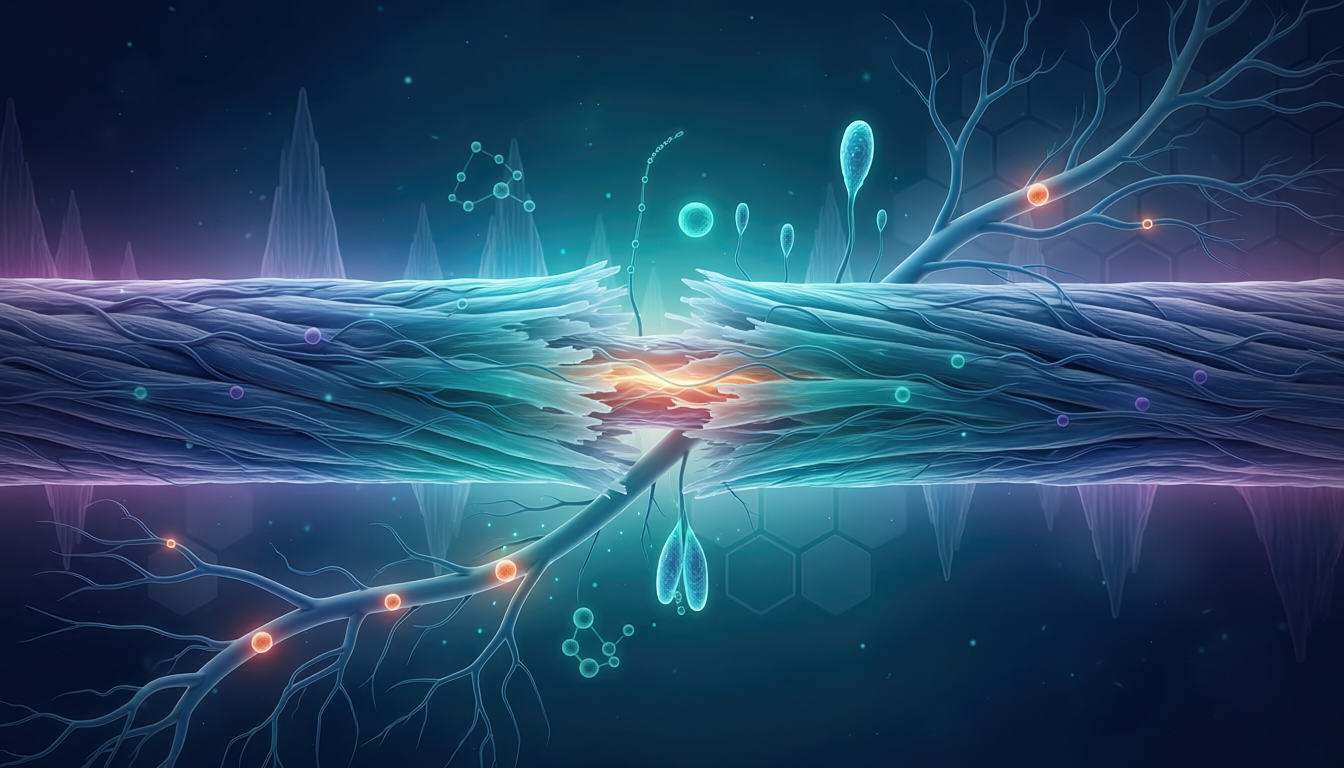
The short answer: BPC-157 is a synthetic peptide (a short chain of amino acids, the building blocks of proteins) that has shown strong, consistent tissue-repair effects in animal studies — particularly in tendons, ligaments, muscle, and the gut lining. Researchers believe it works largely by encouraging angiogenesis (the growth of new small blood vessels) and by activating cell-signaling pathways that help repair cells move to injury sites. But there is an important caveat: almost all of this evidence comes from rodent studies.
What Is BPC-157?
BPC-157 (short for Body Protection Compound-157) is a synthetic 15-amino-acid peptide originally modeled on a fragment found in human gastric juice — the digestive fluid in your stomach. “Synthetic” means it’s manufactured in a lab rather than extracted from the body, and “peptide” simply means a short string of amino acids linked together, smaller than a full protein. In lab studies, BPC-157 is notably resistant to breakdown by digestive enzymes, which is part of why researchers have been able to study its effects when given by different routes in animals (Sikiric et al., 2011).
Most of what’s known about BPC-157 comes from preclinical research — a term that describes lab and animal studies conducted before (or instead of) testing in humans. In these models, researchers have consistently observed accelerated healing across a range of tissue types, including tendon, ligament, muscle, bone, and segments of the gastrointestinal tract (Vasireddi et al., 2025; Sikiric et al., 2019, Gut and Liver).
How BPC-157 Appears to Work: Key Cellular Mechanisms
Animal and cell-culture studies point to several overlapping mechanisms behind BPC-157’s regenerative effects. It’s worth repeating: these pathways have been mapped mainly in rodents and isolated cells, not confirmed in human tissue.
Supporting New Blood Vessel Growth (Angiogenesis)
In animal and cell studies, BPC-157 increases activity of VEGFR2 (Vascular Endothelial Growth Factor Receptor 2), a receptor on blood vessel cells that helps trigger the formation of new capillaries. This appears to work through the PI3K/Akt and eNOS pathways — cell-signaling chains that regulate cell survival and the production of nitric oxide, a molecule that helps blood vessels relax and form (Regeneration or Risk? A Narrative Review of BPC-157, 2025). New blood vessel growth matters for healing because it restores blood flow — and with it, oxygen and nutrients — to injured tissue.
Helping Repair Cells Migrate to Injury Sites
For tissue to rebuild, specialized repair cells called fibroblasts need to physically travel into the wound area. Lab studies on tendon fibroblasts found that BPC-157 increased activation of FAK (Focal Adhesion Kinase) and paxillin — two proteins that help cells grip, move, and reorganize their internal skeleton. In one cell-culture study, BPC-157 increased fibroblast migration and cell survival under oxidative stress, a state where excess reactive molecules damage cells (Chang et al., 2011, Journal of Applied Physiology).
Nitric Oxide Signaling
BPC-157 appears to interact with the body’s nitric oxide system, a signaling pathway involved in blood vessel dilation and tissue protection. Reviews describe this as working through Src-Caveolin-1-eNOS signaling, supporting local blood flow at injury sites in animal models without the systemic blood-pressure effects seen with some other nitric oxide-related compounds (Sikiric et al., 2019).
Reducing Inflammatory Signaling
Animal studies also report that BPC-157 reduces markers of inflammation and supports the activation of extracellular signal-regulated kinase (ERK1/2), a signaling protein involved in cell growth and tissue remodeling, alongside early growth-response genes tied to collagen formation (Vasireddi et al., 2025).
Where the Research Focuses: Tendons, Ligaments, and Gut Tissue
Tendons, ligaments, and cartilage naturally have limited blood supply — a property researchers call “hypovascularity” — which is part of why these tissues tend to heal slowly after injury (Gwyer et al., 2019, systematic review). This low-blood-flow environment is exactly where BPC-157’s angiogenic effects have drawn the most research interest.
Tendon and Ligament Studies
In rat studies of surgically transected Achilles tendons and detached rotator cuff tendons, BPC-157 administration was associated with faster functional recovery, improved biomechanical strength (how much load the tissue could bear before failing), and more organized collagen formation compared to untreated animals (Sikiric lab, Journal of Orthopaedic Research, 2003). A 2025 systematic review in the HSS Journal pooled 36 studies (35 preclinical, 1 clinical) and found consistent musculoskeletal benefits across muscle, tendon, ligament, and bone injury models in animals (Vasireddi et al., 2025).
Gastrointestinal Tissue
BPC-157 was originally studied for gut protection, and animal research shows it accelerates healing of intestinal anastomoses (surgical reconnections of the bowel), fistulas, and models of colitis (Sikiric et al., 2017, World Journal of Gastroenterology).
What Human Evidence Actually Exists
This is the most important context to understand. As of the most recent systematic review (2025), researchers screened 544 published BPC-157 papers and found only one clinical (human) study that met inclusion criteria for orthopedic use — a retrospective, uncontrolled case series in which 7 of 12 patients with chronic knee pain reported relief lasting more than six months after an intra-articular injection (Vasireddi et al., 2025, HSS Journal). There have been no randomized, placebo-controlled human trials for musculoskeletal indications.
In short: the preclinical signal is broad and fairly consistent, but it has not yet been confirmed in well-designed human trials.
Regulatory Status and Safety Considerations
It has no monograph in the U.S. Pharmacopeia, meaning there’s no official, standardized reference for its identity or purity. Animal toxicity studies have also flagged some safety signals — including changes in blood clotting time and liver enzymes at higher repeated doses — that have not been fully characterized in longer-term studies. BPC-157 is also listed on the World Anti-Doping Agency’s prohibited substances list (Vasireddi et al., 2025).
The Plain-English Breakdown
Think of an injured tendon as a construction site that’s lost its delivery infrastructure. Without functioning roads (blood vessels), building supplies (oxygen, nutrients, and repair proteins) can’t reach the crew. In animal studies, BPC-157 appears to act like a site coordinator: it helps open new access roads by promoting blood vessel growth, and it helps activate the signals that call repair cells to the area. That’s a reasonable, evidence-based way to picture the mechanism — but it’s a picture drawn almost entirely from rodent experiments, not confirmed human biology.
Frequently Asked Questions
Does BPC-157 work in humans, or only in animals?
The evidence base is overwhelmingly animal-based. A 2025 systematic review found only one clinical human study met inclusion criteria out of 544 papers reviewed for orthopedic applications, and it was a small, uncontrolled case series (Vasireddi et al., 2025). Whether the mechanisms seen in rodents translate to meaningful clinical benefit in humans has not been established.
What does BPC-157 actually do at the cellular level?
In preclinical models, it appears to promote new blood vessel formation (angiogenesis), support the migration of repair cells like fibroblasts, and interact with nitric oxide signaling — mechanisms studied mainly through the VEGFR2/Akt/eNOS and FAK-paxillin pathways (Regeneration or Risk?, 2025).
Is BPC-157 safe?
This hasn’t been adequately established in humans. Animal toxicity studies identified some safety signals at higher repeated doses that warrant further research.
Why is BPC-157 often mentioned alongside TB-500?
They’re studied for complementary, non-overlapping mechanisms in preclinical research: BPC-157 for blood vessel growth and TB-500 (a fragment of Thymosin Beta-4) for cell movement via the actin cytoskeleton. Neither has been validated in controlled human trials for these purposes.
Educational Disclaimer
This article is for educational and scientific-communication purposes only. It does not constitute medical advice and is not a recommendation to use BPC-157 or any peptide. If you’re considering any peptide therapy, talk with your own licensed healthcare provider first, and use our free Peptide Calculator to sanity-check dosing and reconstitution math before you start.
Want to go deeper? The Flow BioLabs Recovery Stack is all three systems in sequence: Deep Sleep Rebuild, Metabolic & Mitochondrial Optimization, and Lab Interpretation. See the program →