
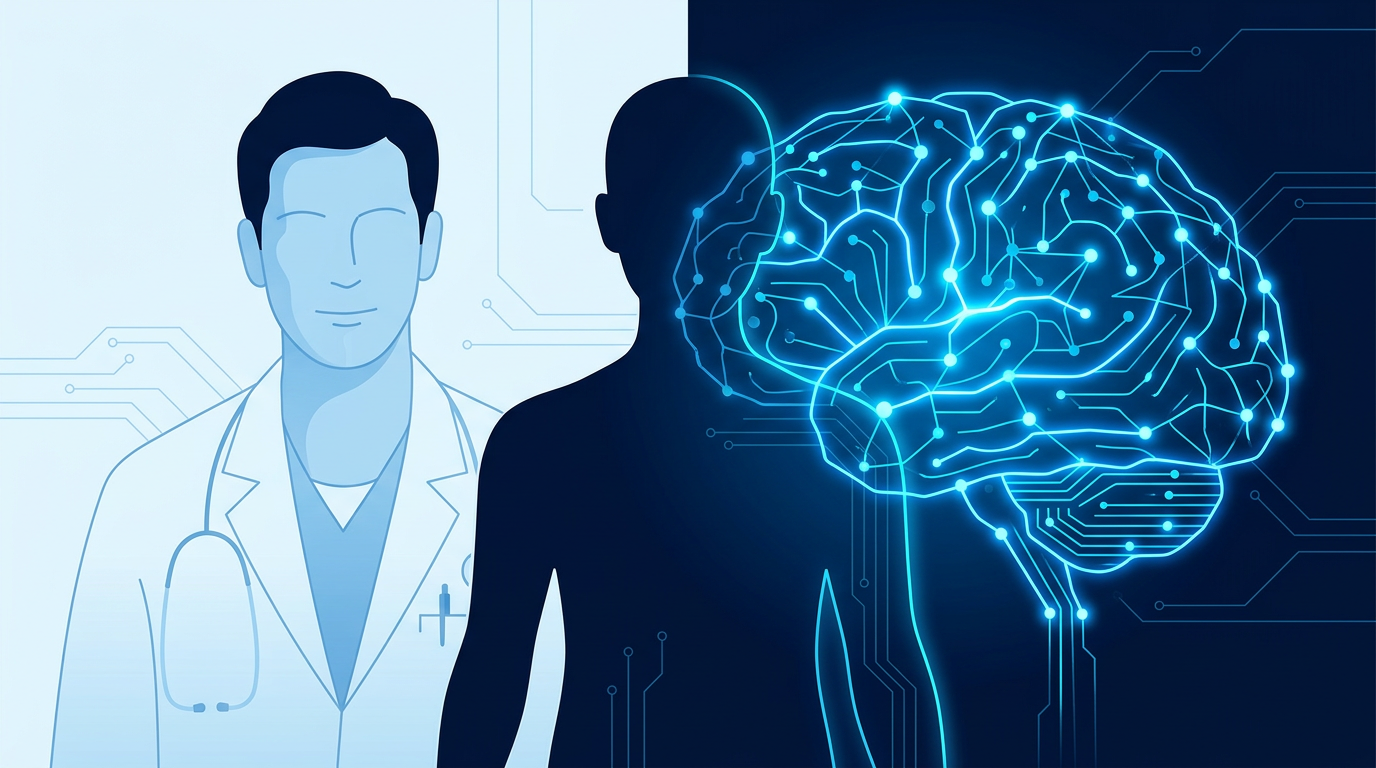
My doctors couldn’t figure out what was wrong with me. Two AI systems, working independently of each other, did.
I went to doctors. They ran their tests. Nothing showed up. “Nothing’s wrong with you” is a sentence that should terrify you more than a diagnosis, because it usually just means “we don’t know.”
So I turned to AI. I asked Claude. Separately, without either one seeing the other’s answer, I asked ChatGPT. Neither model was fed the other’s response. Neither was coached toward an answer I wanted to hear. And they landed on the same conclusion — a conclusion no human doctor I’d seen had reached.
That’s not a miracle. It’s not magic. It’s what happens when you compare a system that can hold the entire body of recent medical literature in working memory, that never gets tired, never has eight minutes to see you, and never has a pharmaceutical rep in the waiting room, against a system — the human doctor — that is doing its best inside constraints most patients never see: insurance-dictated visit lengths, incentive structures, and a training pipeline that rewards test scores over curiosity.
I’m not a doctor. I’m not a scientist. I’m someone who believes AI is already better than the average human doctor at the actual cognitive work of medicine — and I’m not alone, and I’m not guessing. Here’s the research.
This is not a fringe opinion. It’s a live debate at the top of American medicine right now.
In August 2026, bioethicist Dr. Ezekiel Emanuel — a University of Pennsylvania professor and one of the most cited voices in U.S. health policy — published a paper in JAMA, co-authored with Curai Health CEO Neal Khosla and venture investor Vinod Khosla, arguing that autonomous AI, operating without a human physician in the loop, will likely soon exceed the performance of both unaided physicians and physicians using AI as a tool.
Their claim wasn’t a hunch. They reviewed every study comparing AI to physicians published since January 1, 2024, and found that in the large majority of them, AI performed as well as or better than human doctors across five core tasks: gathering patient information, building a differential diagnosis, selecting the right tests, prescribing guideline-concordant treatment, and managing chronic disease.
The American Medical Association pushed back hard. AMA Chief Medical Officer Dr. John Whyte argued publicly that medicine isn’t a “completion of tasks” — that trust, nuance, and the physician relationship can’t be reduced to benchmark scores. It’s a real disagreement, and a healthy one. But notice what it is not: nobody serious is disputing that AI’s raw diagnostic performance has jumped dramatically since 2024. The argument is about what to do with that fact, not whether it’s true.
This debate isn’t happening in a vacuum. People are already voting with their behavior: roughly 1 in 6 American adults now use AI chatbots at least monthly for health information, and searches for “what is my illness” have jumped 85% since January 2025. Nearly two-thirds of people using AI for health questions are checking symptoms specifically. The public didn’t wait for medicine’s institutions to settle this argument — they moved first.
I land on Emanuel’s side. Here’s why, in the actual data.
The evidence: AI is already outperforming doctors on the tasks that matter most
Google’s AMIE beat primary care physicians on 30 of 32 clinical performance measures
The most rigorous head-to-head study to date comes from Google Research. Their diagnostic AI system, AMIE (Articulate Medical Intelligence Explorer), was tested against 20 primary care physicians in a blinded, randomized crossover study using 159 real-world-style case scenarios sourced from clinicians in Canada, the UK, and India — evaluated like a standard medical board exam (an OSCE).
The result: AMIE showed greater diagnostic accuracy than the physicians, and outperformed them on 30 out of 32 axes as scored by specialist physicians, and 25 out of 26 axes as scored by the patient-actors themselves — including communication and empathy. This was published in Nature in 2025, one of the most rigorously peer-reviewed journals in the world.
Google then extended AMIE to handle images, lab results, and clinical documents — the messy multimodal reality of real medicine — and ran it against physicians again. The updated system, published in Nature Medicine in 2026, outperformed primary care physicians on both diagnostic accuracy and empathy in the same study design.
Microsoft’s AI system hit 80% diagnostic accuracy on hard cases. Physicians averaged 20%.
Microsoft AI’s research team built a system called MAI-DxO, which orchestrates multiple AI models to work through diagnosis the way a panel of specialists would. They tested it against 304 of the hardest diagnostic cases ever published — real, complex cases from the New England Journal of Medicine’s clinicopathological conference archive, the gold standard for diagnostic difficulty.
MAI-DxO reached the correct diagnosis 80% of the time. A comparison group of experienced physicians, working the same cases without AI assistance, averaged 20% — a four-fold gap. And the AI did it at 20% lower cost than the physicians’ approach, and 70% lower cost than using an off-the-shelf AI model without the orchestration layer.
AI is already beating physicians at managing chronic disease over time — not just single diagnoses
A follow-up AMIE study published in Nature in 2026 pushed further: instead of a single diagnostic visit, researchers tested AI on multi-visit disease management — the ongoing, months-long work of adjusting a treatment plan as a chronic condition evolves. AMIE was tested against 21 primary care physicians across 100 case scenarios built around UK National Institute for Health and Care Excellence (NICE) and BMJ Best Practice guidelines.
AMIE matched the physicians overall and outperformed them on several measures of management reasoning — including treatment precision, investigation precision, and how closely the plan followed clinical guidelines. This is precisely the category of care — hypertension, diabetes, thyroid regulation, the slow chronic conditions most people actually live with — where the current system of 15-minute visits and disconnected follow-ups fails patients the hardest.
Independent physician reviewers preferred AI answers to real doctors’ answers — and rated them more empathetic
Before the current wave of studies, a widely cited JAMA Internal Medicine study set the template for this whole line of research. Researchers pulled 195 real patient questions from Reddit’s r/AskDocs — where verified physicians answer for free — and had licensed healthcare professionals compare those physician answers to ChatGPT’s answers, blind, without knowing which was which. The panel preferred the AI’s answers 79% of the time, rating them both higher quality and more empathetic than the human physicians’ answers. This is the study that first got mainstream medicine to take the idea seriously; everything Google and Microsoft have published since 2024 has confirmed and extended it.
Even in a real clinical setting, not just simulations, AI outperformed physician assistants and nurse practitioners on differential diagnosis
Skeptics rightly point out that a lot of AI-medicine research happens in simulated environments. So Google ran AMIE in a real ambulatory primary care clinic, comparing its output to physician assistants, nurse practitioners, and physicians. AMIE’s differential diagnosis included the eventual confirmed diagnosis in 90% of cases, with 75% top-3 accuracy — and outperformed the human clinicians on the quality of the intake and differential diagnosis itself. The one place humans still won: practicality and cost-efficiency of the treatment plan — a logistics and system-access problem, not a medical-reasoning one.
Even the doctors themselves are voting with their behavior
If AI were unreliable junk, you’d expect the people with the most to lose — practicing physicians — to avoid it. The opposite is happening. According to the American Medical Association’s own March 2026 survey, 81% of physicians now report using AI in their clinical work, up from roughly half that just three years earlier. The number of doctors using AI professionally has doubled since 2023.
Why doctors miss things AI doesn’t
This isn’t about doctors being bad people. It’s about the system they’re trapped in, and the biology of being human.
Diagnostic error is a documented, massive, ongoing public health crisis — not a rare event. Research led by Johns Hopkins’ Armstrong Institute for Patient Safety, published in BMJ Quality & Safety, estimated that diagnostic errors in the U.S. contribute to roughly 795,000 deaths or permanent disabilities every year, concentrated heavily in stroke, sepsis, pneumonia, blood clots, and lung cancer — the conditions where speed and precision matter most. A separate, widely cited analysis estimated that about 1 in 20 U.S. adults — roughly 12 million people a year — receives a misdiagnosis.
The average American doctor spends around 15 minutes with a patient, buried under administrative burden that both sides of the AMA/Emanuel debate agree is a real problem. AI doesn’t get tired at 4pm. It doesn’t anchor on the last similar case it saw last week (a well-documented human bias called recency bias). It doesn’t need to be reminded that a symptom combination it’s seen only once in training is still worth taking seriously. And it isn’t influenced by which pharmaceutical rep bought lunch that week.
None of that makes AI infallible. It makes it differently fallible — in ways that, per the actual published data since 2024, fail less often than the human alternative on the specific tasks of eliciting symptoms, building a differential diagnosis, and following evidence-based guidelines.
What this means for you right now
I’m not telling you to fire your doctor. I’m telling you what the last two years of published research actually show, so you can make an informed decision instead of a fearful one.
Here’s the practical version, and it’s worth noting that even AMA CEO Dr. Whyte — who disagrees with the “AI-only” framing — agrees with this much: use AI to think through your symptoms before your appointment. Ask it what questions you should be asking your doctor. If your doctor runs the standard workup and tells you nothing is wrong but your symptoms haven’t gone away, don’t stop there. Get a second opinion — human or AI, and ideally both. The data says two independent, correct answers pointing the same direction is a far stronger signal than any one source alone, human or otherwise.
That’s exactly what happened to me. It’s exactly why Flow BioLabs exists.
Why we’re building what we’re building
We started building our own knowledge system at Flow BioLabs for a simple reason: the gap between what current AI models already know and what the average person can access, understand, and act on is enormous — and it’s the people with the least access to specialists, the least time off work to sit in a waiting room, and the least money for a second opinion who are paying for that gap with their health.
Emanuel himself said something worth repeating: the first people to benefit from autonomous AI in medicine will be the people who are uninsured, under-resourced, and living in rural areas without access to specialists. Not because AI is a downgrade for them — because for a huge number of people, the honest current alternative isn’t “AI vs. a great doctor.” It’s “AI vs. an eight-minute visit with no doctor at all, or no visit.”
That’s the gap we’re building to close. More on that soon.
Frequently asked questions
Is AI actually more accurate than doctors at diagnosis? In multiple peer-reviewed, head-to-head studies published since 2024 — including Google’s AMIE research (Nature, 2025 and 2026) and Microsoft AI’s MAI-DxO study — AI systems matched or outperformed physicians on diagnostic accuracy, guideline-concordant treatment planning, and chronic disease management reasoning, under blinded, controlled comparison conditions.
Why do doctors misdiagnose patients so often? Research from Johns Hopkins’ Armstrong Institute estimates roughly 795,000 Americans are seriously harmed or die annually due to diagnostic error, with contributing factors including short visit times, administrative burden, cognitive biases like recency bias, and systemic incentive structures — not a lack of individual competence or effort.
Should I stop seeing doctors and rely only on AI? No major researcher on either side of this debate — including AI’s strongest proponents — recommends removing human oversight entirely from serious diagnoses, prescriptions, or treatment decisions today. The realistic, evidence-backed approach is using AI as a rigorous, always-available first opinion and bringing its findings to a physician, particularly for anything urgent or serious.
What is AMIE, Google’s AI doctor? AMIE (Articulate Medical Intelligence Explorer) is a large-language-model-based AI system built by Google Research specifically for diagnostic dialogue and disease management. In multiple published studies (2024–2026), it has outperformed primary care physicians on diagnostic accuracy, guideline adherence, and even empathy, as scored by both specialist physicians and patient-actors.
Is the “AI vs. doctors” debate settled? No. It’s an active, high-profile debate in mainstream medicine, playing out between researchers like Dr. Ezekiel Emanuel and organizations like the American Medical Association. What’s not seriously disputed is that AI’s diagnostic performance has improved dramatically since 2024 — the disagreement is about how much autonomy AI should be given, not whether it’s gotten good.
Can AI answer medical questions better than a doctor? In a widely cited JAMA Internal Medicine study, licensed physicians reviewing real patient questions preferred ChatGPT’s answers over other physicians’ answers 79% of the time — rating the AI’s responses both more accurate and more empathetic, in a blinded comparison.
Why are so many people using AI to self-diagnose now? Access and speed. Roughly 1 in 6 U.S. adults use AI chatbots monthly for health information, and searches for symptom-related questions have risen sharply since 2025 — driven by short doctor visits, high costs, and limited specialist access, not a rejection of medicine itself.
Sources: Emanuel EJ, Baker-Butler A, Khosla N, Khosla V. “Will Autonomous AI Exceed AI-Aided Physicians as the Best Medical Care?” JAMA, August 2026. Tu T, et al. “Towards conversational diagnostic artificial intelligence.” Nature, 2025. “Advancing conversational diagnostic AI with multimodal reasoning.” Nature Medicine, 2026. “Towards conversational AI for disease management.” Nature, 2026. Nori H, et al. “Sequential Diagnosis with Language Models” (MAI-DxO). Microsoft AI Research, 2025. Ayers JW, et al. “Comparing Physician and Artificial Intelligence Chatbot Responses to Patient Questions.” JAMA Internal Medicine, 2023. Newman-Toker DE, et al. “Burden of serious harms from diagnostic error in the USA.” BMJ Quality & Safety, 2023. American Medical Association physician AI adoption survey, March 2026.
Want the next signal before it hits the mainstream?
Get The Signal Letter: real research, no hype, straight to your inbox. Join readers who want the evidence-backed version of stories like this one.
Want to go deeper? The 21-Day Metabolic Friction Reset is a day-by-day, 21-day plan for removing the everyday friction behind stalled progress. See the program →