
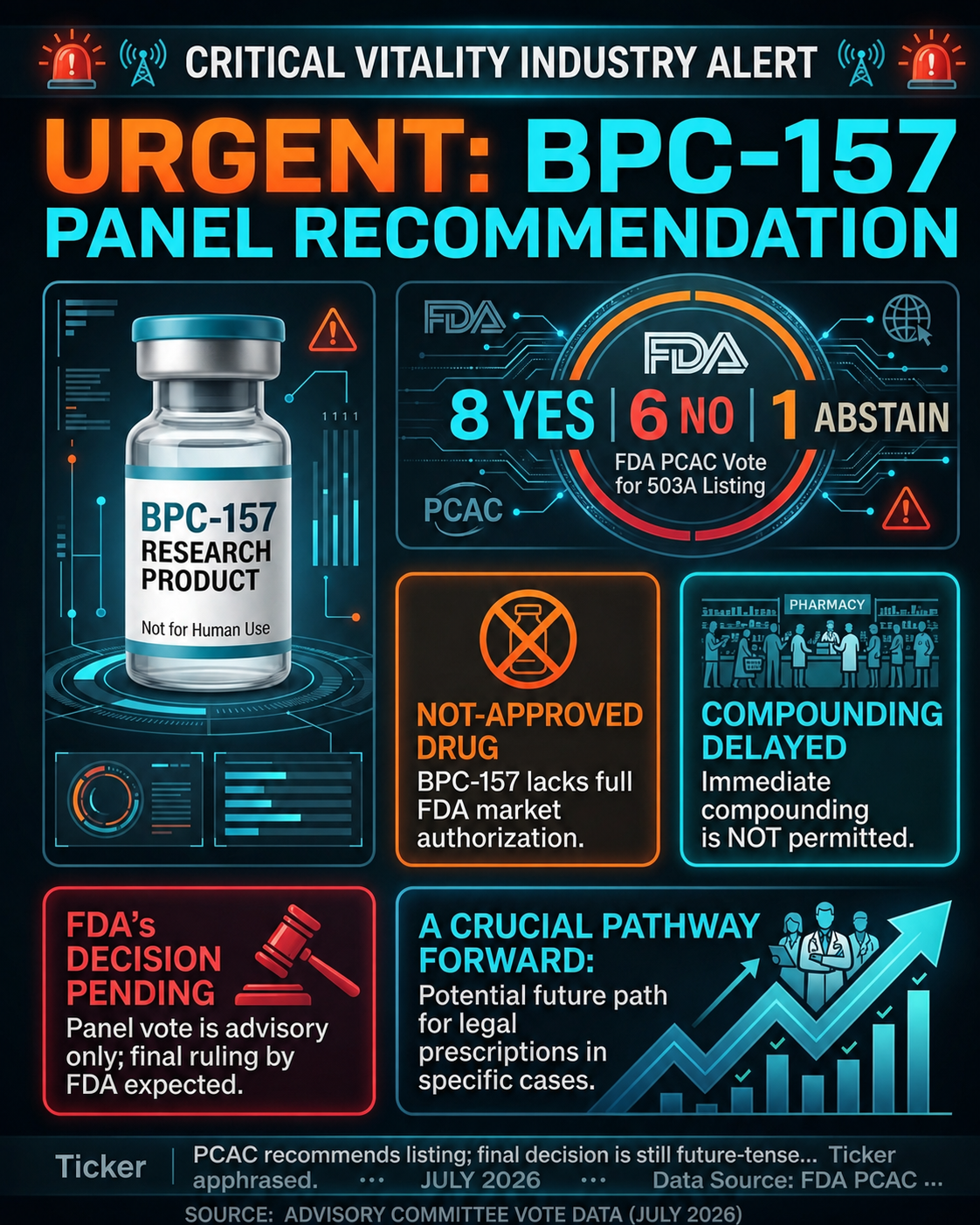
On July 23, 2026, an FDA advisory panel voted to recommend BPC-157 for a list that would let compounding pharmacies legally prepare it for patients with a prescription. That’s a real, meaningful step — but it’s not the same as FDA approval, and it doesn’t change what’s legal today.
Here’s exactly what happened, what it means, and what’s still unresolved.
What the FDA panel actually voted on
The FDA’s Pharmacy Compounding Advisory Committee (PCAC) — a group of outside experts that advises the agency on which bulk substances compounding pharmacies may use — met on July 23 and 24, 2026, to review seven peptides for possible inclusion on the FDA’s Section 503A Bulk Drug Substances List (FDA Advisory Committee Calendar). That list names the specific ingredients a state-licensed compounding pharmacy is allowed to use to prepare a customized medication for an individual patient who has a prescription.
On the first day, the committee voted 8 in favor, 6 against, with 1 abstention to recommend BPC-157 (both the free-base and acetate forms) for the list — the specific use under review was ulcerative colitis (McDermott Will & Schulte, 2026; Reuters). TB-500 and KPV received the identical 8-6-1 result on the same day, and MOTS-c was recommended 7-5-2. On day two, Epitalon and Semax were also recommended, while emideltide (DSIP) was not (voted down 6-7-1).
What made the vote notable: the FDA’s own scientific staff had recommended against adding any of the seven peptides, citing insufficient safety data, insufficient effectiveness data, and unresolved questions about how consistently the peptides can be manufactured and verified for purity (FDA Briefing Document, PCAC Meeting, July 2026). The committee’s vote went against that staff recommendation for BPC-157, TB-500, KPV, MOTS-c, Epitalon, and Semax — a split that several outlets described as unusual (CNN; STAT News).
What BPC-157 is
BPC-157 (Body Protection Compound-157) is a synthetic peptide — a short chain of amino acids, the building blocks of proteins — modeled on a protective protein found in human gastric juice. It has drawn attention in biohacking, longevity, and sports-recovery circles for its studied effects on tendon, muscle, ligament, and gut-lining repair in animal research. It is not an FDA-approved drug, and there is no completed large-scale human clinical trial establishing its safety or effectiveness for any condition (FDA Briefing Document, PCAC Meeting, July 2026).
What this vote does — and doesn’t — change today
It’s worth being precise here, because “the FDA is legalizing BPC-157” is not an accurate summary of what happened.
- The vote is a recommendation, not a rule. PCAC is an advisory committee; it doesn’t have authority to change the law. The FDA can accept, reject, or delay acting on its recommendation (McDermott Will & Schulte, 2026).
- Nothing is legal to compound yet. To formally add BPC-157 to the 503A list, the FDA has to go through notice-and-comment rulemaking: publish a proposed rule, collect public comments, then issue a final rule. That process realistically runs into 2027 or later (McDermott Will & Schulte, 2026).
- It is not FDA drug approval. Even if BPC-157 is eventually added to the 503A list, that only means a licensed compounding pharmacy could prepare it for a specific patient with a prescription. It would still not have gone through the clinical-trial process the FDA uses to approve a drug as safe and effective for a given condition (Reuters).
- The FDA has historically followed most PCAC recommendations, but not always. An FDA official confirmed the agency has gone against a PCAC recommendation at least once before, so this outcome isn’t guaranteed (STAT News).
Why the committee split from FDA staff
This wasn’t a rubber-stamp vote — six of fourteen voting members sided with FDA staff and voted against recommending BPC-157. Public reporting on the meeting points to a few recurring themes in the discussion: strong demand from patients and prescribers already using these peptides through the existing (and more restrictive) research-chemical and off-label pathways, arguments that formal compounding oversight would improve product quality and safety compared with unregulated vendors, and pushback from some committee members who felt the human safety and effectiveness evidence genuinely isn’t there yet (CNN; Medical Daily). Some committee members reportedly conditioned their “yes” votes on future safeguards, such as requiring sourcing from authorized suppliers and mandatory adverse-event reporting if the peptides are eventually added to the list (McDermott Will & Schulte, 2026).
What to actually watch next
If you’re following this because you’re curious about BPC-157 for your own recovery or performance goals, here’s the realistic timeline and what matters:
- Watch the Federal Register, not headlines, for the FDA’s proposed rule — that’s the next concrete step, and it isn’t scheduled yet.
- Nothing about legal access has changed this week. BPC-157 is still not on the 503A Bulk Drug Substances List, still not FDA-approved, and pharmacies still can’t lawfully compound it under this specific pathway.
- If you’re already using it or considering it, talk with a licensed provider who understands the current regulatory gray area and the actual (still-thin) human safety data, rather than relying on marketing claims from any vendor. For dosing and reconstitution questions, our free Peptide Calculator walks through the math. Always confirm any protocol with your own licensed physician.
Frequently Asked Questions
Is BPC-157 legal now?
It’s legal to buy and possess as a research-use-only chemical, and it isn’t a scheduled controlled substance. But it is not FDA-approved as a drug, and licensed compounding pharmacies still cannot legally prepare it for patients under the 503A pathway this vote concerns. The July 2026 PCAC vote is a recommendation, not a rule change.
Did the FDA approve BPC-157?
No. An advisory committee recommended BPC-157 for a compounding-ingredients list by an 8-6 vote with one abstention. FDA drug approval is a completely different, more rigorous process involving clinical trials, and no such process for BPC-157 is publicly underway.
When could BPC-157 actually become legal to compound?
No date has been set. The FDA must complete formal notice-and-comment rulemaking — a proposed rule, a public comment period, and a final rule — which industry observers estimate could take from several months to more than a year, likely stretching into 2027.
Why did the panel vote against its own FDA staff’s recommendation?
Reporting on the meeting points to strong public and prescriber demand, arguments that regulated compounding would be safer than unregulated research-chemical sales, and some members weighing patient access more heavily than the staff’s safety-data concerns. It’s a genuinely split outcome — six of fourteen voting members agreed with FDA staff and voted no.
This article is for educational purposes and reflects the regulatory status as of August 2026. It is not medical or legal advice. Regulatory status can change; verify current status before making decisions.